Portal:Suriname

The Suriname portal
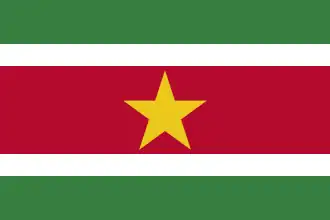
Suriname, officially the Republic of Suriname, is a country in northern South America, also considered as part of the Caribbean and the West Indies. Situated slightly north of the equator, over 90% of its territory is covered by rainforest, the highest proportion of forest cover in the world. Suriname is bordered by the Atlantic Ocean to the north, French Guiana to the east, Guyana to the west, and Brazil to the south. It is the smallest country in South America by both population and territory, with around 612,985 inhabitants in 2021 in an area of approximately 165,940 square kilometers (64,070 square miles).0 The capital and largest city is Paramaribo, which is home to roughly half the population. Suriname was inhabited as early as the fourth millennium BC by various indigenous peoples, including the Arawaks, Caribs, and Wayana. Europeans arrived and contested the area in the 16th century, with the Dutch controlling much of the country's current territory by the late 17th century. Under Dutch rule, Suriname was a lucrative plantation colony focused mostly on sugar; its economy was driven by African slave labour until the abolition of slavery in 1863. Approximately 300,000 enslaved Africans were taken to Suriname during the transatlantic slave trade, from the mid-1600s to the early 1800s. After 1863, indentured servants were recruited mostly from British India and the Dutch East Indies. In 1954, Suriname became a constituent country of the Kingdom of the Netherlands. On 25 November 1975, it became independent following negotiations with the Dutch government. Suriname continues to maintain close diplomatic, economic, and cultural ties with the Netherlands. Surinamese culture and society strongly reflect the legacy of Dutch colonial rule. It is the only independent state outside Europe where Dutch is the official and prevailing language of government, business, media, and education; an estimated 60% of the population speaks Dutch as a native language. Sranan Tongo, an English-based creole language, is a widely used lingua franca. Most Surinamese are descendants of slaves brought from Africa by Europeans, and indentured labourers brought from Asia by the Dutch. Suriname is highly diverse, with no ethnic group forming a majority; proportionally, its Muslim and Hindu populations are some of the largest in the Americas. Most people live along the northern coast, centred on Paramaribo, making Suriname one of the least densely populated countries on Earth. It is a developing country with a high level of human development; its economy is heavily dependent on its abundant natural resources, namely bauxite, gold, petroleum, and agricultural products. Suriname is a member of the Caribbean Community (CARICOM), the United Nations, the Organisation of Islamic Cooperation and the Organization of American States. (Full article...) Selected article - The Suriname River (Dutch: Surinamerivier) is 480 kilometres (300 mi) long and flows through the country of Suriname. Its sources are located in the Guiana Highlands on the border between the Wilhelmina Mountains and the Eilerts de Haan Mountains (where it is known as the Gran Rio). The source of the Upper Suriname River is at the confluence of the Gran Rio and Pikin Rio near the village of Goddo. The river continues shortly after the reservoir along Brokopondo as the Lower Suriname River. Than it flows Berg en Dal, the migrant communities Klaaskreek and Nieuw-Lombé, Jodensavanne, Carolina, Ornamibo and Domburg, before reaching the capital Paramaribo on the left bank and Meerzorg on the right bank. At Nieuw-Amsterdam it is joined by the Commewijne and immediately thereafter at the sandspit Braamspunt it flows into the Atlantic Ocean. The river has several sets of rapids as well as a few dams, the largest of which is the Afobaka Dam. The river's flow is interrupted by the Brokopondo Reservoir, which therefore divides the river into two sections. The upstream section runs almost entirely through the Sipaliwini district, and the downstream section runs through the Brokopondo, Para, Commewijne, Wanica and Paramaribo districts. (Full article...) General imagesThe following are images from various Suriname-related articles on Wikipedia.
Selected biography -Pim de la Parra (5 January 1940 – 6 September 2024) was a Surinamese-Dutch film director. (Full article...)
Selected picture Sea Captains Carousing in Surinam
by John Greenwood Map Map of Suriname Topics
Categories Select [►] to view subcategories
Suriname Suriname-related lists Buildings and structures in Suriname Culture of Suriname Economy of Suriname Education in Suriname Environment of Suriname Geography of Suriname Government of Suriname Health in Suriname History of Suriname Organisations based in Suriname Surinamese people Politics of Suriname Society of Suriname Images of Suriname Suriname stubs Related portalsWikiProjects
Things to do
WikimediaThe following Wikimedia Foundation sister projects provide more on this subject:
SourcesDiscover Wikipedia using portals
| ||||||||||||||||||||||||||||||||||||||||||||||||||||||||||||||||||||||||||||||||||||||||||||

.svg.png)


_Edit.jpg)
_01.jpg)

.jpg)


%252C_by_John_Gabriel_Stedman%252C_1796.jpg)
%252C_2022_-_10.jpg)

%252C_2022_-_2.jpg)


.jpg)


.svg.png)


.jpg)