Portal:History

The History Portal

Historia by Nikolaos Gyzis
History is the systematic study of the past, focusing primarily on the human past. As an academic discipline, it analyses and interprets evidence to construct narratives about what happened and explain why it happened. Some theorists categorize history as a social science, while others see it as part of the humanities or consider it a hybrid discipline. Similar debates surround the purpose of history—for example, whether its main aim is theoretical, to uncover the truth, or practical, to learn lessons from the past. In a more general sense, the term history refers not to an academic field but to the past itself, times in the past, or to individual texts about the past.
Historical research relies on primary and secondary sources to reconstruct past events and validate interpretations. Source criticism is used to evaluate these sources, assessing their authenticity, content, and reliability. Historians strive to integrate the perspectives of several sources to develop a coherent narrative. Different schools of thought, such as positivism, the Annales school, Marxism, and postmodernism, have distinct methodological approaches.
History is a broad discipline encompassing many branches. Some focus on specific time periods, such as ancient history, while others concentrate on particular geographic regions, such as the history of Africa. Thematic categorizations include political history, military history, social history, and economic history. Branches associated with specific research methods and sources include quantitative history, comparative history, and oral history.
History emerged as a field of inquiry in antiquity to replace myth-infused narratives, with influential early traditions originating in Greece, China, and later in the Islamic world. Historical writing evolved throughout the ages and became increasingly professional, particularly during the 19th century, when a rigorous methodology and various academic institutions were established. History is related to many fields, including historiography, philosophy, education, and politics. (Full article...)
 Featured articles –
-


The 4th-century AD Ezana Stone containing a dual Sabaean-style Ge'ez and Greek inscription recording the victories of King Ezana of Axum over the Kushites of Meroe (in modern Sudan)
Ethiopian historiography includes the ancient, medieval, early modern, and modern disciplines of recording the history of Ethiopia, including both native and foreign sources. The roots of Ethiopian historical writing can be traced back to the ancient Kingdom of Aksum (c. AD 100 – c. 940). These early texts were written in either the Ethiopian Ge'ez script or the Greek alphabet, and included a variety of mediums such as manuscripts and epigraphic inscriptions on monumental stelae and obelisks documenting contemporary events. The writing of history became an established genre in Ethiopian literature during the early Solomonic dynasty (1270–1974). In this period, written histories were usually in the form of royal biographies and dynastic chronicles, supplemented by hagiographic literature and universal histories in the form of annals. Christian mythology became a linchpin of medieval Ethiopian historiography due to works such as the Orthodox Kebra Nagast. This reinforced the genealogical traditions of Ethiopia's Solomonic dynasty rulers, which asserted that they were descendants of Solomon, the legendary King of Israel.
Ethiopian historiographic literature has been traditionally dominated by Christian theology and the chronology of the Bible. There was also considerable influence from Muslim, pagan and foreign elements from within the Horn of Africa and beyond. Diplomatic ties with Christendom were established in the Roman era under Ethiopia's first Christian king, Ezana of Axum, in the 4th century AD, and were renewed in the Late Middle Ages with embassies traveling to and from medieval Europe. Building on the legacy of ancient Greek and Roman historical writings about Ethiopia, medieval European chroniclers made attempts to describe Ethiopia, its people, and religious faith in connection to the mythical Prester John, who was viewed as a potential ally against Islamic powers. Ethiopian history and its peoples were also mentioned in works of medieval Islamic historiography and even Chinese encyclopedias, travel literature, and official histories. (Full article...) -
The battle of Powick Bridge was a skirmish fought on 23 September 1642 south of Worcester, England, during the First English Civil War. It was the first engagement between elements of the principal field armies of the Royalists and Parliamentarians. Sir John Byron was escorting a Royalist convoy of valuables from Oxford to King Charles's army in Shrewsbury and, worried about the proximity of the Parliamentarians, took refuge in Worcester on 16 September to await reinforcements. The Royalists despatched a force commanded by Prince Rupert. Meanwhile, the Parliamentarians sent a detachment, under Colonel John Brown, to try to capture the convoy. Each force consisted of around 1,000 mounted troops, a mix of cavalry and dragoons.
The Parliamentarians approached the city from the south on the afternoon of 23 September. Their route took them up narrow lanes and straight into Rupert's force, which was resting in a field. The noise of the approaching Parliamentarian cavalry alerted the Royalists, who quickly formed up. The Royalist dragoons gave their cavalry time to prepare, firing at point-blank range as the Parliamentarians emerged into the field. Rupert's cavalry then charged and broke most of the Parliamentarian cavalry, although one troop stood its ground and returned fire. Ultimately, all the Parliamentarians were routed. (Full article...) -
Philip I Epiphanes Philadelphus (Ancient Greek: Φίλιππος Ἐπιφανής Φιλάδελφος; between 124 and 109 BC–83 or 75 BC) was a Hellenistic Seleucid monarch who reigned as the king of Syria from 94 to either 83 or 75 BC. The son of Antiochus VIII and his wife Tryphaena, he spent his early life in a period of civil war between his father and his uncle Antiochus IX. The conflict ended with the assassination of Antiochus VIII; Antiochus IX took power in the Syrian capital Antioch, but soon fell in battle with Antiochus VIII's eldest son Seleucus VI.
After the murder of Seleucus VI in 94 BC, Philip I became king with his twin brother Antiochus XI, and planned to avenge Seleucus VI. In 93 BC Antiochus XI took Antioch from Antiochus IX's son Antiochus X. Antiochus XI became the senior king, and Philip I remained in a base in Cilicia. Antiochus X returned and killed Antiochus XI that year. Philip I then allied with his younger brother Demetrius III, who was based in Damascus. Antiochus X was probably killed in 88 BC. Demetrius III took the capital and besieged Philip I in Beroea (Aleppo), but the latter prevailed and took Antioch; their youngest brother Antiochus XII took Damascus. (Full article...) -
George Andrew Davis Jr. (December 1, 1920 – February 10, 1952) was a highly decorated fighter pilot and flying ace of the United States Army Air Forces in World War II, and later of the United States Air Force during the Korean War. He was killed in action during a combat mission in northwestern Korea, in an area nicknamed "MiG Alley". For his actions during the Korean War, Davis was posthumously awarded the Medal of Honor and promoted from major to lieutenant colonel.
Born in Dublin, Texas, Davis joined the United States Army Air Corps in early 1942. He was sent to the Pacific Theater after pilot training and flew in the New Guinea and Philippine campaigns, scoring seven victories over Japanese aircraft. He quickly gained a reputation as a skilled pilot and accurate gunner whose "daredevil" flying style contrasted with his reserved personality. (Full article...) -
The Fortress of Mimoyecques (French pronunciation: [mimɔjɛk]) is the modern name for a Second World War underground military complex built by the forces of Nazi Germany between 1943 and 1944. It was intended to house a battery of fixed V-3 cannons permanently aimed at London, 165 kilometres (103 mi) away. Originally codenamed Wiese ("Meadow") or Bauvorhaben 711 ("Construction Project 711"), it is located in the commune of Landrethun-le-Nord in the Pas-de-Calais department of northern France, near the hamlet of Mimoyecques about 20 kilometres (12 mi) from Boulogne-sur-Mer. It was constructed by a mostly German workforce recruited from major engineering and mining concerns, augmented by prisoner-of-war slave labour.
The complex consists of a network of tunnels dug under a chalk hill, linked to five inclined shafts in which 25 V-3 guns would have been installed, all aimed at London. The guns would have been able to fire ten dart-like explosive projectiles a minute – 600 rounds every hour – into the British capital, which Winston Churchill later commented would have constituted "the most devastating attack of all". The Allies knew nothing about the V-3 but identified the site as a possible launching base for V-2 ballistic missiles, based on reconnaissance photographs and fragmentary intelligence from French sources. (Full article...) -
The 38th (Welsh) Division (initially the 43rd Division, later the 38th (Welsh) Infantry Division and then the 38th Infantry (Reserve) Division) of the British Army was active during both the First and Second World Wars. In 1914, the division was raised as the 43rd Division of Herbert Kitchener's New Army, and was originally intended to form part of a 50,000-strong Welsh Army Corps that had been championed by David Lloyd George; the assignment of Welsh recruits to other formations meant that this concept was never realised.
The 43rd was renamed the 38th (Welsh) Division on 29 April 1915, and shipped to France later that year. It arrived in France with a poor reputation, seen as a political formation that was ill-trained and poorly led. The division's baptism by fire came in the first days of the Battle of the Somme, where it captured Mametz Wood at the loss of nearly 4,000 men. This strongly held German position needed to be secured in order to facilitate the next phase of the Somme offensive, the Battle of Bazentin Ridge. Despite securing its objective, the division's reputation was adversely affected by miscommunication among senior officers. (Full article...) -
The Beulé Gate (French pronunciation: [bœ'le]) is a fortified gate, constructed in the Roman period, leading to the Propylaia of the Acropolis of Athens. It was constructed almost entirely from repurposed materials (spolia) taken from the Choragic Monument of Nikias, a monument built in the fourth century BCE and demolished between the second and fourth centuries CE. The dedicatory inscription from Nikias's monument is still visible in the entablature of the Beulé Gate.
The gate was integrated into the Post-Herulian Wall, a late Roman fortification built around the Acropolis in the years following the city's sack by the Germanic Heruli people in 267 or early 268 CE. Its construction marked the beginning of a new phase in the Acropolis's use, in which it came to be seen more as a potential defensive position than in the religious terms that had marked its use in the classical period. During the medieval period, the gate was further fortified and closed off, before being built over with a bastion in Ottoman times. (Full article...) -
Operation Ke (ケ号作戦, Ke-gō Sakusen) was the largely successful withdrawal of Japanese forces from Guadalcanal, concluding the Guadalcanal Campaign of World War II. The operation took place between 14 January and 7 February 1943, and involved both Imperial Japanese Army (IJA) and Imperial Japanese Navy (IJN) forces under the overall direction of the Japanese Imperial General Headquarters (IGH). Commanders of the operation included Isoroku Yamamoto and Hitoshi Imamura.
The Japanese decided to withdraw and concede Guadalcanal to Allied forces for several reasons. All attempts by the IJA to recapture Henderson Field, the airfield on Guadalcanal in use by Allied aircraft, had been repulsed with heavy losses. Japanese ground forces on the island had been reduced from 36,000 to 11,000 through starvation, disease, and battle casualties. IJN forces were also suffering heavy losses attempting to reinforce and resupply the ground forces on the island. These losses, plus the projected resources needed for further attempts to recapture Guadalcanal, were affecting strategic security and operations in other areas of the Japanese Empire. The decision to withdraw was endorsed by Emperor Hirohito on 31 December 1942. (Full article...) -
George Smith Patton Jr. (11 November 1885 – 21 December 1945) was a general in the United States Army who commanded the Seventh Army in the Mediterranean Theater of World War II, then the Third Army in France and Germany after the Allied invasion of Normandy in June 1944.
Born in 1885, Patton attended the Virginia Military Institute and the United States Military Academy at West Point. He studied fencing and designed the M1913 Cavalry Saber, more commonly known as the "Patton Saber." He competed in the modern pentathlon at the 1912 Summer Olympics in Stockholm, Sweden, finishing in fifth place. Patton entered combat during the Pancho Villa Expedition of 1916, the United States' first military action using motor vehicles. He fought in World War I as part of the new United States Tank Corps of the American Expeditionary Forces: he commanded the U.S. tank school in France, then led tanks into combat and was wounded near the end of the war. In the interwar period, Patton became a central figure in the development of the army's armored warfare doctrine, serving in numerous staff positions throughout the country. At the United States' entry into World War II, he commanded the 2nd Armored Division. (Full article...) -
The Kragujevac massacre was the mass murder of between 2,778 and 2,794 mostly Serb men and boys in Kragujevac by German soldiers on 21 October 1941. It occurred in the German-occupied territory of Serbia during World War II, and came as a reprisal for insurgent attacks in the Gornji Milanovac district that resulted in the deaths of ten German soldiers and the wounding of 26 others. The number of hostages to be shot was calculated as a ratio of 100 hostages executed for every German soldier killed and 50 hostages executed for every German soldier wounded, a formula devised by Adolf Hitler with the intent of suppressing anti-Nazi resistance in Eastern Europe.
After a punitive operation was conducted in the surrounding villages, during which over 400 males were shot and four villages burned down, another 70 male Jews and communists who had been arrested in Kragujevac were killed. Simultaneously, males between the ages of 16 and 60, including high school students, were assembled by German troops and local collaborators, and the victims were selected from amongst them. The selected males were then marched to fields outside the city, shot with heavy machine guns, and their bodies buried in mass graves. Contemporary German military records indicate that 2,300 hostages were shot. After the war, inflated estimates ranged as high as 7,000 deaths, but German and Serbian scholars have now agreed on the figure of nearly 2,800 killed, including 144 high school students. As well as Serbs, massacre victims included Jews, Romani people, Muslims, Macedonians, Slovenes, and members of other nationalities. (Full article...) -
The 7th Army was a Royal Yugoslav Army formation raised prior to the German-led Axis invasion of Yugoslavia in April 1941, during World War II. It consisted of two divisions, two brigade-strength mountain detachments, and a brigade-strength infantry detachment. It formed part of the 1st Army Group, and was responsible for the defence of Yugoslavia's north-western frontier with Italy and Germany. Like all Yugoslav formations at the time, the 7th Army had serious deficiencies in both mobility and firepower.
Despite concerns over a possible Axis invasion, orders for the general mobilisation of the Royal Yugoslav Army were not issued by the government until 3 April 1941, not to provoke Germany any further following the military coup d'état and precipitate war. When the invasion commenced on 6 April, the 7th Army was only partially mobilised, and on the first day the Germans seized several mountain passes and bridges over the Drava river. Slovene politicians formed a National Council of Slovenia with the intent of separating from Yugoslavia, and on the right flank of the 7th Army, the 4th Army was seriously weakened by Croat fifth column activities within its major units and higher headquarters from the outset. This alarmed the 7th Army commander, Divizijski đeneral Dušan Trifunović, but he was not permitted to withdraw from the border areas until the night of 7/8 April, and this was followed by the German capture of Maribor on 8 April as they continued to expand their bridgeheads, supported by the Luftwaffe. (Full article...) -
HMS Furious was a modified Courageous-class battlecruiser built for the Royal Navy (RN) during the First World War. Designed to support the Baltic Project championed by the First Sea Lord, Lord Fisher, the ship was very lightly armoured and designed with a main battery of only two 18-inch (457 mm) guns. Furious was modified as an aircraft carrier while under construction. Her forward turret was removed and a flight deck was added in its place, such that aircraft had to manoeuvre around the superstructure to land. Later in the war, the ship had her rear turret removed and a second flight deck installed aft of the superstructure, but this was less than satisfactory due to air turbulence. Furious was briefly laid up after the war before she was reconstructed with a full-length flight deck in the early 1920s. Her half-sisters Courageous and Glorious were also rebuilt as aircraft carriers around that time.
After her conversion, Furious was used extensively for trials of naval aircraft, and later as a training ship once large, modern fleet carriers such as Ark Royal entered service in the 1930s. During the early months of the Second World War, the carrier spent her time hunting for German raiders in the North Atlantic and escorting convoys. This changed dramatically during the Norwegian Campaign in early 1940, when her aircraft provided air support to British troops ashore in addition to attacking German shipping. The first of what would be numerous aircraft ferry missions was made by the carrier during the campaign. After the withdrawal of British troops in May, Furious made several anti-shipping strikes in Norway with little result before beginning a steady routine of ferrying aircraft for the Royal Air Force. (Full article...) -
The Anglo-Scottish war (1650–1652), also known as the Third Civil War, was the final conflict in the Wars of the Three Kingdoms, a series of armed conflicts and political machinations between shifting alliances of religious and political factions in England, Scotland and Ireland.
The 1650 English invasion of Scotland was a pre-emptive military incursion by the English Commonwealth's New Model Army, intended to allay the risk of Charles II invading England with a Scottish army. The First and Second English Civil Wars, in which English Royalists, loyal to Charles I, fought Parliamentarians for control of the country, took place between 1642 and 1648. When the Royalists were defeated for the second time the English government, exasperated by the duplicity of Charles I during negotiations, set up a High Court of Justice which found the King guilty of treason and executed him on 30 January 1649. At the time, England and Scotland were separate independent kingdoms, joined politically through a personal union; Charles I was, separately, both the King of Scotland, and the King of England. The Scots had fought in support of the English Parliamentarians in the First English Civil War, but sent an army in support of Charles I into England during the Second English Civil War. The Parliament of Scotland, which had not been consulted before the execution, declared his son, Charles II, King of Britain. (Full article...) -
Samuel Jackson Randall (October 10, 1828 – April 13, 1890) was an American politician from Pennsylvania who represented the Queen Village, Society Hill, and Northern Liberties neighborhoods of Philadelphia from 1863 to 1890 and served as the 44th speaker of the United States House of Representatives from 1876 to 1881. He was a contender for the Democratic Party nomination for President of the United States in 1880 and 1884.
Born in Philadelphia to a family active in Whig politics, Randall shifted to the Democratic Party after the Whigs' demise. His rise in politics began in the 1850s with election to the Philadelphia Common Council and then to the Pennsylvania State Senate for the 1st district. Randall served in a Union cavalry unit in the American Civil War before winning a seat in the federal House of Representatives in 1862. He was re-elected every two years thereafter until his death. The representative of an industrial region, Randall became known as a staunch defender of protective tariffs designed to assist domestic producers of manufactured goods. While often siding with Republicans on tariff issues, he differed with them in his resistance to Reconstruction and the growth of federal power. (Full article...) -

Major General Rupert Major Downes, CMG, KStJ, VD, FRACS (10 February 1885 – 5 March 1945) was an Australian soldier, surgeon and historian.
The son of British Army officer Major Francis Downes, Downes joined the Army as a trumpeter while he was still at school. He attended the University of Melbourne, graduating with his medical degrees in 1907 and a Doctor of Medicine degree in 1911. He was commissioned as a captain in the Australian Army Medical Corps in 1908, and after the outbreak of the First World War he joined the First Australian Imperial Force (AIF) in 1914 as its youngest lieutenant colonel. He served in the Gallipoli campaign, and was appointed Assistant Director of Medical Services (ADMS) of the newly formed Anzac Mounted Division in 1916, which he combined with the post of ADMS AIF Egypt. In 1917, he became Deputy Director of Medical Services (DDMS) of the Desert Mounted Corps. After the war, he wrote articles on medical aspects of the Sinai and Palestine campaign, and the section on the campaign for the Official History of Australia in the War of 1914–1918. (Full article...)


.svg.png)


.jpg)
Featured picture
-
 Photo credit: Berlyn BrixnerThe Trinity nuclear test explosion, .016 seconds after detonation. The fireball is about 200 metres (700 ft) wide. Conducted by the United States on July 16, 1945, at a location 35 miles (56 km) southeast of Socorro, New Mexico, on what is now White Sands Missile Range, Trinity was the first test of technology for a nuclear weapon.
 -
 The "Theatre" at PetraPhoto: Douglas PerkinsPetra is an archaeological site in Jordan, lying in a basin among the mountains which form the eastern flank of Wadi Araba, the great valley running from the Dead Sea to the Gulf of Aqaba. It is famous for having many stone structures carved into the rock.
 -
 Photo: Martin St-AmantMachu Picchu, a 15th-century Peruvian Inca site located 2,430 metres (7,970 ft) above sea level, as viewed from Huayna Picchu. Established c. 1450, the settlement was abandoned at the time of the Spanish Conquest the following century. Although it remained known locally, it was not brought to international attention until after Hiram Bingham visited the site in 1911. Machu Picchu is now a popular tourist destination and UNESCO World Heritage Site, and restoration efforts are ongoing.
 -
 Photo: MyrabellaA historical reenactment is an educational or entertainment activity in which participants follow a prearranged plan to recreate aspects of a historical event or period. Here, a group reenacts the Battle of Waterloo, in which an Imperial French army under the command of Emperor Napoleon Bonaparte was defeated by the armies of the Seventh Coalition.
 -
.jpg) Artist: Unknown, after Johann ZahnA drawing of the Vegetable Lamb of Tartary (Agnus scythicus), a zoophyte of Central Asia. Botanist Henry Lee described it as both a true animal and a living plant, although he did allow for the possibility that the lamb was the fruit of the plant. The lamb was believed to have blood, bones, and flesh like that of a normal lamb. It was connected to the earth by a stem similar to an umbilical cord that propped the lamb up above ground. The cord could flex downward allowing the lamb to feed on the grass and plants surrounding it. Once the plants within reach were eaten, the lamb died, at which point its cotton-like wool would be harvested and used to make textiles.
Artist: Unknown, after Johann ZahnA drawing of the Vegetable Lamb of Tartary (Agnus scythicus), a zoophyte of Central Asia. Botanist Henry Lee described it as both a true animal and a living plant, although he did allow for the possibility that the lamb was the fruit of the plant. The lamb was believed to have blood, bones, and flesh like that of a normal lamb. It was connected to the earth by a stem similar to an umbilical cord that propped the lamb up above ground. The cord could flex downward allowing the lamb to feed on the grass and plants surrounding it. Once the plants within reach were eaten, the lamb died, at which point its cotton-like wool would be harvested and used to make textiles. -
 Photograph: Masoud SafarniyaAn Iranian astrolabe, handmade from brass by Jacopo Koushan in 2013. Astrolabes are elaborate inclinometers used by astronomers, navigators, and astrologers from classical antiquity, through the Islamic Golden Age and European Middle Ages, until the Renaissance. These could be used for a variety of purposes, including predicting the positions of the Sun, Moon, planets, and stars; determining local time given local latitude; surveying; triangulation; calculating the qibla; and finding the times for salat.
 -
 A Chola dynasty sculpture depicting Shiva. In Hinduism, Shiva is the deity of destruction and one of the most important gods; in this sculpture he is dancing as Nataraja, the divine dancer who unravels the world in preparation for it being remade by Brahma.
 -
 Painting: Henry WaltonEdward Gibbon (1737–1794) was an English historian who published The History of the Decline and Fall of the Roman Empire in six volumes between 1776 and 1788. Born in Putney, Surrey, he became a voracious reader while being raised by his aunt, and was sent to study at Magdalen College, Oxford, and in Switzerland. Returning to England, in 1761 Gibbon published his first book, Essai sur l'Étude de la Littérature. This was well received, but Gibbon's next book was a failure. In the early 1770s Gibbon began writing his history of the Roman Empire, which was received with great praise.
 -
 Photograph credit: Diego DelsoThe Arg-e Bam, in Kerman Province in southeastern Iran, is the largest adobe building in the world and a UNESCO World Heritage Site. The ancient citadel has a history dating back around two thousand years, to the Parthian Empire (248 BC – 224 AD), but most of its buildings were constructed during the Safavid dynasty. A strong earthquake on 26 December 2003 largely devastated the fortress and the nearby modern city of Bam. The Arg-e Bam, including the governor's residence, the main tower, the Four Seasons Palace and the hammam, were nearly totally destroyed; this photograph from 2016 shows the citadel partially reconstructed.
 -
 Photo credit: Gustaf NordenskiöldAn 1891 photograph of Cliff Palace, the largest cliff dwelling—a structure built within caves and under outcroppings in cliffs—in North America, located in what is now Mesa Verde National Park, Colorado, USA. There are about 150 rooms in the 288 ft (88 m) long structure, although only 25 to 30 of those were used as living space by Ancient Pueblo peoples. it is estimated that the population of Cliff Palace was roughly 100–150 people.
 -
 Artist: William Simpson; Restoration: Lise BroerA lithograph of a watercolour painting depicting soldiers transporting winter clothing, lumber for huts, and other supplies through a snow-covered landscape, with partially buried dead horses along the roadside, to the British camps, during the Siege of Sevastopol of the Crimean War. In the winter, a storm ruined the camps and supply lines of the Allied forces (France, Britain and the Ottoman Empire). Men and horses became sick and starved in the poor conditions.
 -
 Painting by Benjamin HaydonBenjamin Haydon's painting of Thomas Clarkson addressing the 1840 Anti-Slavery Convention, held by the Anti-Slavery Society at Exeter Hall in London. The organisation was the second to bear that name and was dedicated to the abolishment of slavery worldwide. It continues to function today as Anti-Slavery International.
 -
 Photograph: Andrew ShivaAn aerial view of Masada, an ancient fortification in the Southern District of Israel. Found atop an isolated rock plateau, it overlooks the Dead Sea. The first fortifications on the mountain were built by Alexander Jannaeus, and significantly strengthened by the Roman client king Herod between 37 and 31 BCE. During the First Jewish–Roman War of 66–73 CE, the fortress was besieged, falling only after the 960 Sicarii defending it committed mass suicide.
Masada is among the more popular tourist attractions in Israel, and in 2001 it was made a UNESCO World Heritage Site. -
 Photo credit: USHMMJews captured by SS and SD troops during the suppression of the Warsaw Ghetto Uprising are forced to leave their shelter and march to the Umschlagplatz for deportation. The SD trooper pictured second from the right, is Josef Blösche, who was identified by Polish authorities using this photograph. Blösche was tried for war crimes in Erfurt, East Germany in 1969, sentenced to death and executed in July of that year.
 -
![Image 15 Apollo 11 Photograph credit: Neil Armstrong Apollo 11 was the fifth crewed mission of NASA's Apollo program. After launching from the Kennedy Space Center in Florida on July 16, 1969, commander Neil Armstrong and Apollo Lunar Module pilot Buzz Aldrin landed Eagle in Mare Tranquillitatis on July 20, at 20:17:40 UTC, while command module pilot Michael Collins remained on Columbia in lunar orbit. Armstrong was the first to exit the spacecraft, stepping onto the surface 6 hours and 39 minutes later, on July 21, at 02:56:15 UTC; nineteen minutes later, Aldrin joined him on extravehicular activity, which lasted 2 hours, 31 minutes and 40 seconds. Armstrong and Aldrin lifted off from Tranquility Base after almost 22 hours on the lunar surface and rejoined Collins in the command module, before splashing down in the Pacific Ocean on July 24. The mission was planned to the minute, with the majority of the photographic tasks performed by Armstrong with a single Hasselblad camera. Most of the photographs taken on the Moon that include an astronaut are of Aldrin; there are only five images of Armstrong partly shown or reflected, as in this photograph, with Armstrong and the lunar module reflected in Aldrin's helmet visor. "As the sequence of lunar operations evolved," Aldrin explained, "Neil had the camera most of the time [...] It wasn't until we were back on Earth and in the Lunar Receiving Laboratory looking over the pictures that we realized there were few pictures of Neil." More featured pictures](./_assets_/0c70a452f799bfe840676ee341124611/Aldrin_Apollo_11_original.jpg) Photograph credit: Neil ArmstrongApollo 11 was the fifth crewed mission of NASA's Apollo program. After launching from the Kennedy Space Center in Florida on July 16, 1969, commander Neil Armstrong and Apollo Lunar Module pilot Buzz Aldrin landed Eagle in Mare Tranquillitatis on July 20, at 20:17:40 UTC, while command module pilot Michael Collins remained on Columbia in lunar orbit. Armstrong was the first to exit the spacecraft, stepping onto the surface 6 hours and 39 minutes later, on July 21, at 02:56:15 UTC; nineteen minutes later, Aldrin joined him on extravehicular activity, which lasted 2 hours, 31 minutes and 40 seconds. Armstrong and Aldrin lifted off from Tranquility Base after almost 22 hours on the lunar surface and rejoined Collins in the command module, before splashing down in the Pacific Ocean on July 24.
Photograph credit: Neil ArmstrongApollo 11 was the fifth crewed mission of NASA's Apollo program. After launching from the Kennedy Space Center in Florida on July 16, 1969, commander Neil Armstrong and Apollo Lunar Module pilot Buzz Aldrin landed Eagle in Mare Tranquillitatis on July 20, at 20:17:40 UTC, while command module pilot Michael Collins remained on Columbia in lunar orbit. Armstrong was the first to exit the spacecraft, stepping onto the surface 6 hours and 39 minutes later, on July 21, at 02:56:15 UTC; nineteen minutes later, Aldrin joined him on extravehicular activity, which lasted 2 hours, 31 minutes and 40 seconds. Armstrong and Aldrin lifted off from Tranquility Base after almost 22 hours on the lunar surface and rejoined Collins in the command module, before splashing down in the Pacific Ocean on July 24.
The mission was planned to the minute, with the majority of the photographic tasks performed by Armstrong with a single Hasselblad camera. Most of the photographs taken on the Moon that include an astronaut are of Aldrin; there are only five images of Armstrong partly shown or reflected, as in this photograph, with Armstrong and the lunar module reflected in Aldrin's helmet visor. "As the sequence of lunar operations evolved," Aldrin explained, "Neil had the camera most of the time [...] It wasn't until we were back on Earth and in the Lunar Receiving Laboratory looking over the pictures that we realized there were few pictures of Neil." -
 Image credit: Julius Magnus PetersenA medieval ship flag captured by forces from Lübeck in the 1420s showed the arms of Denmark, Sweden, Norway and Pomerania. At the time, Denmark, Norway and Sweden were united in the Kalmar Union. The flag is believed to originate from the reign of king Eric of Pomerania due to its inclusion of Pomerania's griffin symbol. For the following five hundred years, the flag was displayed as a war trophy in a Lübeck church until destroyed during a World War II air raid on the city. An 1880s copy of the flag is preserved in the museum at Frederiksborg Palace, Denmark. The saint accompanying the Virgin Mary and infant Christ is Saint James the Greater, identified by his scallop shell emblem. The flag was made of coarse linen. All figures and heraldic insignia were created using oil-based paint.
 -
.jpg) Document: John, King of England, his barons and Stephen LangtonCotton MS Augustus II.106, one of four surviving exemplifications of Magna Carta. This document, sealed by King John of England on 15 June 1215 (O.S.), was drafted by the Archbishop of Canterbury to make peace between the unpopular king and a group of rebel barons. The charter promised the protection of church rights, protection for the barons from illegal imprisonment, access to swift justice, and limitations on feudal payments to the Crown.
Document: John, King of England, his barons and Stephen LangtonCotton MS Augustus II.106, one of four surviving exemplifications of Magna Carta. This document, sealed by King John of England on 15 June 1215 (O.S.), was drafted by the Archbishop of Canterbury to make peace between the unpopular king and a group of rebel barons. The charter promised the protection of church rights, protection for the barons from illegal imprisonment, access to swift justice, and limitations on feudal payments to the Crown.
The document was reissued and renewed several times over the centuries, though its political impact decreased as later laws were passed. The charter was significant because the king had agreed to limit his power, so that although it dealt predominantly with the king and the barons, since the late 16th century it has been considered a symbol of liberty and the freedom of the individual. -
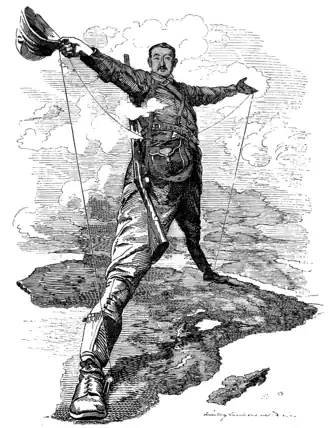 Illustration: Edward Linley SambourneThe Rhodes Colossus is an iconic editorial cartoon of the Scramble for Africa period, depicting British colonialist Cecil John Rhodes as a giant standing over the continent, after his announcement of plans to extend an electrical telegraph line from Cape Town to Cairo. Rhodes is shown in a visual pun as the ancient Greek statue the Colossus of Rhodes, with his right foot in Cape Town and his left in Cairo, illustrating his broader "Cape to Cairo" concept for British domination of Africa.
Did you know (auto generated)

- ... that Centre's 1921 defeat of Harvard is widely considered to be one of the greatest upsets in college football history?
- ... that the flatbread luchi was historically made with bananas instead of water?
- ... that the Labour Party received their highest share of the vote to date in the 1951 UK general election but still lost to the Conservatives, who received fewer votes?
- ... that a 2001 book shares the history of a small Tudor community through a 54-year-long "running commentary" by "a somewhat unamiable busybody"?
- ... that alongside a 7th-century BC Phoenician shipwreck, two additional wrecks from various historical periods were unearthed in Bajo de la Campana, situated off the coast of Cartagena, Spain?
- ... that the Irwin Union Bank's glass walls and open-plan layout, uncommon for an American bank building of its time, led to its designation as a historic landmark?
Featured biography –
.jpg)
Simeon I the Great (Church Slavonic: цѣсар҄ь Сѷмеѡ́нъ А҃ Вели́къ; Bulgarian: цар Симеон I Велики, romanized: Simeon I Veliki [simɛˈɔn ˈpɤrvi vɛˈliki]; Greek: Συμεών Αʹ ὁ Μέγας, romanized: Sumeṓn prôtos ho Mégas) was the ruler of the First Bulgarian Empire from 893 until his death in 927. Simeon's successful campaigns against the Byzantines, Magyars and Serbs led Bulgaria to its greatest territorial expansion ever, making it the most powerful state in contemporary Eastern and Southeast Europe. His reign was also a period of unmatched cultural prosperity and enlightenment later deemed the Golden Age of Bulgarian culture.
During Simeon's rule, Bulgaria spread over a territory between the Aegean, the Adriatic and the Black seas. The newly independent Bulgarian Orthodox Church became the first new patriarchate besides the Pentarchy, and Bulgarian Glagolitic and Cyrillic translations of Christian texts spread all over the Slavic world of the time. It was at the Preslav Literary School in the 890s that the Cyrillic alphabet was developed. Halfway through his reign, Simeon assumed the title of "emperor" (Tsar), having prior to that been styled "prince" (Knyaz). (Full article...)
On this day
February 16: J'ouvert morning, Carnival begins in Trinidad and Tobago; Chinese New Year's Eve (2026); Day of the Shining Star in North Korea; Presidents' Day in the United States (2026); Elizabeth Peratrovich Day in Alaska; Daisy Gatson Bates Day in Arkansas (2026)

- 1270 – Livonian Crusade: In the Battle of Karuse, the Grand Duchy of Lithuania achieved a decisive victory over the Livonian Order on the frozen surface of the Baltic Sea.
- 1900 – The Southern Cross Expedition led by Carsten Borchgrevink (pictured) achieved a new Farthest South of 78° 50'S, making the first landing at the Great Ice Barrier.
- 1936 – The Popular Front, a coalition of left-wing parties, came to power in the Spanish general election, a factor in the outbreak of the Spanish Civil War five months later.
- 1961 – The DuSable Museum, the first museum dedicated to the study and conservation of African American history, culture, and art, was chartered.
- 2013 – At least 91 people were killed and 190 others injured after a bomb hidden in a water tank exploded at a market in Hazara Town, Pakistan.
- Roberta Williams (b. 1953)
- Valentino Rossi (b. 1979)
- Yan Bingtao (b. 2000)
- Boutros Boutros-Ghali (d. 2016)
Selected quote
If you wish to avoid foreign collision, you had better abandon the ocean.
— Henry Clay, American statesman
Related portals
More Did you know...

- ... that, when Ghenadie Petrescu (pictured) was ousted from his post of Metropolitan-Primate, Romania experienced protests and riots?
- ... that the British destroyer HMS Highlander escorted Convoy SC 122 through the largest convoy battle of World War II in March 1943 and was unsuccessfully attacked by U-441 and U-608?
- ... that in 1911, John Gaunt's second biplane nearly crashed because a bystander bent the aircraft's elevator before a flight?
- ... that Themistokli Gërmenji, an Albanian nationalist, received the French Croix de Guerre in November 1917, but was executed shortly thereafter by a French military court?
- ... that fish-knives inscribed with Elokeshi's name were sold after her husband decapitated her with a fish-knife following her adulterous affair with a Hindu head-priest?
- ... that the ancient Roman dancer Galeria Copiola reached the age of 104?
- ... that to escape burning at the 1393 Bal des Ardents Charles VI of France huddled under the gown of the Duchesse de Berry, while a lord leaped into a wine vat?
- ... that a junior officer on the USS Ancon refused King George VI entry to the ship's intelligence centre because no one told him the King "was a Bigot"?
Topics
| Primary | |
|---|---|
| Interdisciplinary |
|
| List | |
| Other categorizations | |
| |

| Key concepts | |||||||||
|---|---|---|---|---|---|---|---|---|---|
| Measurement and standards |
| ||||||||
| Philosophy of time | |||||||||
| |||||||||
| Human experience and use of time | |||||||||
| Time in science |
| ||||||||
| Related | |||||||||
| |||||||||
Categories

History • By period • By region • By topic • By ethnic group • Historiography • Archaeology • Books • Maps • Images • Magazines • Organizations • Fictional • Museums • Pseudohistory • Stubs • Timelines • Chronology • People • Wikipedia historians
WikiProjects
 WikiProject History •
Ancient Near East • Australian History • Classical Greece and Rome • Dacia • Former countries • History of Canada • Chinese history • European history • Heraldry and vexillology • Indian history • Jewish history • Medieval Scotland • Mesoamerica • Military history • Middle Ages • History of Science
WikiProject History •
Ancient Near East • Australian History • Classical Greece and Rome • Dacia • Former countries • History of Canada • Chinese history • European history • Heraldry and vexillology • Indian history • Jewish history • Medieval Scotland • Mesoamerica • Military history • Middle Ages • History of Science
WikiProject Time • Days of the Year • Years
WikiProject Biography • Composers • Political figures • Saints • United States Presidents
Things you can do
 |
Here are some tasks awaiting attention:
|
Associated Wikimedia
The following Wikimedia Foundation sister projects provide more on this subject:
-
 Commons
Free media repository -
 Wikibooks
Free textbooks and manuals -
 Wikidata
Free knowledge base -
 Wikinews
Free-content news -
 Wikiquote
Collection of quotations -
 Wikisource
Free-content library -
 Wikiversity
Free learning tools -
 Wiktionary
Dictionary and thesaurus
-
 List of all portals
 -

-

-

-

-

-

-

-

-

-
 Random portal
 -
 WikiProject Portals