Portal:Politics

| Main | Topics and categories | Tasks and projects |
The Politics portal
.jpg)
Politics is the set of activities that are associated with making decisions in groups, or other forms of power relations among individuals, such as the distribution of status or resources. The branch of social science that studies politics and government is referred to as political science.
Politics may be used positively in the context of a "political solution" which is compromising and non-violent, or descriptively as "the art or science of government", but the word often also carries a negative connotation. The concept has been defined in various ways, and different approaches have fundamentally differing views on whether it should be used extensively or in a limited way, empirically or normatively, and on whether conflict or co-operation is more essential to it.
A variety of methods are deployed in politics, which include promoting one's own political views among people, negotiation with other political subjects, making laws, and exercising internal and external force, including warfare against adversaries. Politics is exercised on a wide range of social levels, from clans and tribes of traditional societies, through modern local governments, companies and institutions up to sovereign states, to the international level.
In modern states, people often form political parties to represent their ideas. Members of a party often agree to take the same position on many issues and agree to support the same changes to law and the same leaders. An election is usually a competition between different parties.
A political system is a framework which defines acceptable political methods within a society. The history of political thought can be traced back to early antiquity, with seminal works such as Plato's Republic, Aristotle's Politics, Confucius's political manuscripts and Chanakya's Arthashastra. (Full article...)
Selected article
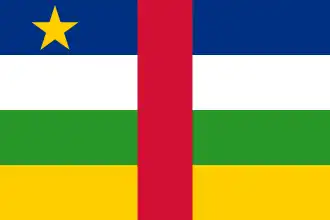
The Saint-Sylvestre coup d'état was a coup d'état staged by Jean-Bédel Bokassa, leader of the Central African Republic army, and his military officers against the government of President David Dacko on 31 December 1965 and 1 January 1966. Dacko was aware that Bokassa had made plans to take over his government, and countered by forming the gendarmerie headed by Jean Izamo. Bokassa and his men started the coup on New Year's Eve in 1965 by first capturing Izamo and locking him in a cellar at Camp de Roux. They then occupied the capital, Bangui, and overpowered the gendarmerie and other resistance. After midnight, Dacko was arrested and forced to resign from office and then imprisoned at Camp Kassaï. According to official reports, eight people died while resisting the coup. Izamo was tortured to death within a month, but Dacko's life was spared due to foreign intervention. Soon after the coup, Bokassa dissolved the National Assembly, abolished the Constitution and issued a number of decrees, banning begging, female circumcision, and polygamy, among other things. Bokassa initially struggled to obtain international recognition for his regime, but the new government eventually obtained recognition from other African nations.
Featured picture
.jpg)
Dr. Javier Solana was the High Representative for the Common Foreign and Security Policy and the Secretary-General of both the Council of the European Union (EU) and the Western European Union (WEU). This photograph shows him discussing with students of RWTH Aachen University, one day before receiving the International Charlemagne Prize of the city of Aachen.
 Featured lists -
-
 The Parliament of Canada is the legislative body of the government of Canada. The Parliament is composed of the House of Commons (lower house), the Senate (upper house), and the sovereign, represented by the governor general. Most major legislation originates from the Commons, as it is the only body that is directly elected. A new parliament begins after an election of the House of Commons and can sit for up to five years. The number of seats in parliament has varied as new provinces joined the country and as population distribution between the provinces changed; there are currently 343 House MPs and 105 Senators (when there are no vacancies).
Canada uses a Westminster-style parliamentary government, in which the leader of the party with the most seats in the House of Commons becomes Prime Minister, even if the leader is not an elected member of parliament. The leader of the party with the second-most seats in the House becomes the leader of the Official Opposition, and debate (formally called Oral Questions) between the parties is presided over by the speaker of the House. When the party with the most seats has less than half of the total number of seats, it forms a minority government, which can be voted out of power by the other parties. The Canadian Parliament is located at Parliament Hill in the capital city, Ottawa, Ontario. (Full article...) -

The crest of Jesus College above the entrance on Ship Street
Jesus College is one of the constituent colleges of the University of Oxford in England. The college was founded in 1571 by Queen Elizabeth I at the request of Hugh Price, a Welsh clergyman, who was Treasurer of St David's Cathedral in Pembrokeshire. The college still has strong links with Wales, and about 15% of students are Welsh. There are 340 undergraduates and 190 students carrying out postgraduate studies. Women have been admitted since 1974, when the college was one of the first five men's colleges to become co-educational. Old members of Jesus College are sometimes known as "Jesubites".
Harold Wilson studied at Jesus College from 1934 to 1937, and was later the prime minister of the United Kingdom during two periods (from October 1964 to June 1970, and from March 1974 to April 1976). More than 30 other Members of Parliament (MPs) have been educated at the college, from Sir John Salusbury who was elected as MP for Denbighshire in 1601 to Theresa Villiers who was elected as MP for Chipping Barnet in 2005. Sir Leoline Jenkins, who became a Fellow and later the Principal of the college, was Secretary of State for the Northern Department from 1680 to 1681 and Secretary of State for the Southern Department from 1681 to 1685. Sir William Williams served as Speaker of the House of Commons from 1680 to 1685 and as Solicitor General for England and Wales from 1687 to 1689. Evan Cotton was MP for Finsbury East before holding the position of President of the Bengal Legislative Council from 1922 to 1925. Several Welsh politicians have been educated at the college, some representing constituencies in Wales (such as Sir John Wogan, representing Pembrokeshire at various times between 1614 and 1644) and others working outside Parliament, such as D. J. Williams, a co-founder of the Welsh nationalist party Plaid Cymru. (Full article...) -

Location of New Brunswick in Canada
New Brunswick is the eighth-most populous province in Canada, with 775,610 residents as of the 2021 census, and the third-smallest province by land area, at 71,248.50 km2 (27,509.20 mi2). New Brunswick's 104 municipalities, as of 2021, covered only 10.9% of the province's land mass but were home to 69.5% of its population.
Local governments in New Brunswick may be incorporated under the Local Governance Act of 2017. Local governments include municipalities – cities, towns, and villages – as well as rural communities and regional municipalities. Municipal governments are led by elected councils and are responsible for the delivery of services such as civic administration, land use planning, emergency measures, policing, road, and garbage collection. (Full article...) -
 Number of seats won by major parties at each election
- UCP
- Wildrose
- Conservative/PC
- Liberal
- CCF/NDP
- Social Credit
- United Farmers
- Dominion Labour Party
- Independents
- Other
The Canadian province of Alberta holds elections to its unicameral legislative body, the Legislative Assembly of Alberta. The maximum period between general elections of the assembly is five years, but the Lieutenant Governor is able to call one at any time. However, the premier has typically asked the lieutenant governor to call the election in the fourth or fifth year after the preceding election. The number of seats has increased over time, from 25 for the first election in 1905, to the current 87.
Alberta's politics has historically been one of long-lasting governments with government changes being few and far between. The province from 1905 to 2015 was ruled by four "dynasties": the Liberal Party (1905–1921); the United Farmers of Alberta (1921–1935), the Social Credit Party (1935–1971), and the Progressive Conservative (PC) Association (1971–2015), the longest political dynasty in Canada. Since 2015 Alberta has had two different governments: The Alberta New Democratic party led by Rachel Notley (2015-2019) and United Conservative Party (2019 to the present). In every election one party has taken a majority of seats. No minority government has ever been elected in Alberta. Thus, Alberta can be said to have continuously had a dominant-party system for its entire political history, though the dominant party has changed over time. (Full article...) -
There are 62 counties in the U.S. state of New York.
The first 12 counties were created in 1683 soon after the British took over the Dutch colony of New Amsterdam; two of these counties were later abolished, their land going to Massachusetts. These counties were carried over after independence in 1783, but most of the counties were created by the state in the 19th century. The newest county is the Bronx, created in 1914 from the portions of New York County that had been annexed from Westchester County in the late 19th century. New York's counties are named for various Native American words; British provinces, counties, cities, and royalty; early American statesmen and military personnel; and New York State politicians. (Full article...) -
%252C_signed_image_for_Walter_Nash_(NZ_Prime_Minister)%252C_1958_(16017609534).jpg)
The president of India is the head of state of the Republic of India and the supreme commander of the Indian Armed Forces. The president is referred to as the first citizen of India. Although vested with these powers by the Constitution of India, the position is largely a ceremonial one and executive powers are de facto exercised by the prime minister.
The president is elected by the Electoral College composed of elected members of the parliament houses, the Rajya Sabha and the Lok Sabha, and also members of the Vidhan Sabha, the state legislative assemblies. Presidents may remain in office for a tenure of five years, as stated by article 56, part V, of the Constitution of India. In the case where a president's term of office is terminated early or during the absence of the president, the vice president assumes office. By article 70 of part V, the parliament may decide how to discharge the functions of the president where this is not possible, or in any other unexpected contingency. (Full article...) -

There are 67 counties in the U.S. state of Florida, which became a territory of the U.S. in 1821 with two counties complementing the provincial divisions retained as a Spanish territory, Escambia to the west and St. Johns to the east. The two counties were divided by the Suwannee River. All of the other counties were created later from these two original counties. Florida became the 27th U.S. state in 1845, and its last county was created in 1925 with the formation of Gilchrist County from a segment of Alachua County. Florida's counties are subdivisions of the state government. Florida's most populous county is Miami-Dade County, the seventh most populous county in the nation, with a population of 2,701,767 as of the 2020 census.
In 1968, counties gained the power to develop their own charters. All but two of Florida's county seats are incorporated municipalities: the exceptions are Crawfordville, county seat of rural Wakulla County, and East Naples, located outside Naples city limits in Collier County. (Full article...) -
The sultans of the Ottoman Empire (Turkish: Osmanlı padişahları), who were all members of the Ottoman dynasty (House of Osman), ruled over the transcontinental empire from its perceived inception in 1299 to its dissolution in 1922. At its height, the Ottoman Empire spanned an area from Hungary in the north to Yemen in the south and from Algeria in the west to Iraq in the east. Administered at first from the city of Söğüt since before 1280 and then from the city of Bursa since 1323 or 1324, the empire's capital was moved to Adrianople (now known as Edirne in English) in 1363 following its conquest by Murad I and then to Constantinople (present-day Istanbul) in 1453 following its conquest by Mehmed II.
The Ottoman Empire's early years have been the subject of varying narratives, due to the difficulty of discerning fact from legend. The empire came into existence at the end of the 13th century, and its first ruler (and the namesake of the Empire) was Osman I. According to later, often unreliable Ottoman tradition, Osman was a descendant of the Kayı tribe of the Oghuz Turks. The eponymous Ottoman dynasty he founded endured for six centuries through the reigns of 36 sultans. The Ottoman Empire disappeared as a result of the defeat of the Central Powers, with whom it had allied itself during World War I. The partitioning of the Empire by the victorious Allies and the ensuing Turkish War of Independence led to the abolition of the sultanate in 1922 and the birth of the modern Republic of Turkey in 1922. (Full article...) -

The President of the Indian National Congress is the chief executive of the Indian National Congress (INC), one of the principal political parties in India, founded by retired British civil servant Allan Octavian Hume. Constitutionally, the president is elected by an electoral college composed of members drawn from the Pradesh Congress Committees and members of the All India Congress Committee (AICC). In the event of any emergency because of any cause such as the death or resignation of the president elected as above, the most senior general secretary discharges the routine functions of the president until the Working Committee appoints a provisional president pending the election of a regular president by the AICC. The president of the party has effectively been the party's national leader, head of the party's organisation, head of the Working Committee, the chief spokesman, and all chief Congress committees.
After the party's foundation in December 1885, Womesh Chandra Banerjee became its first president. From 1885 to 1933, the presidency had a term of one year only. From 1933 onwards, there was no such fixed term for the president. During Jawaharlal Nehru's premiership, he rarely held the Presidency of INC, even though he was always head of the Parliamentary Party. Despite being a party with a structure, Congress under Indira Gandhi did not hold any organisational elections after 1978. In 1978, Gandhi split from the INC and formed a new opposition party, popularly called Congress (I), which the national election commission declared to be the real Indian National Congress for the 1980 general election. Gandhi institutionalised the practice of having the same person as the Congress president and the prime minister of India after the formation of Congress (I). Her successors Rajiv Gandhi and P. V. Narasimha Rao also continued that practice. Nonetheless, in 2004, when the Congress was voted back into power, Manmohan Singh became the first and only prime minister not to be the president of the party since establishment of the practice of the president holding both positions. (Full article...) -

2025 BJP CM History
The Bharatiya Janata Party (BJP) is one of the two major parties in the political system of the Republic of India, the other being the Indian National Congress (INC). As of 2015, it is the country's largest political party in terms of representation in the national parliament. Established in 1980, the BJP's platform is generally considered as the right-wing of the political spectrum. As of 20 February 2025, 55 BJP leaders have held the position of a chief minister out of which fourteen are incumbent.
A chief minister is the head of government of each of the twenty-eight states and two union territories (UTs) (Delhi and Puducherry). According to the Constitution of India, at the state-level, the governor is de jure head, but de facto executive authority rests with the chief minister. Following elections to the state legislative assembly, the governor usually invites the party (or coalition) with a majority of seats to form the government. The governor appoints the chief minister, whose council of ministers are collectively responsible to the assembly. The chief minister's term is usually for a maximum of five years, with the confidence of the assembly's confidence. There are no limits to the number of terms the chief minister can serve. (Full article...) -
There are 114 counties and one independent city in the U.S. State of Missouri. Following the Louisiana Purchase and the admittance of Louisiana into the United States in 1812, five counties were formed out of the Missouri Territory at the first general assembly: Cape Girardeau, New Madrid, Saint Charles, Saint Louis, and Ste. Genevieve. Most subsequent counties were apportioned from these five original counties. Six more counties were added through the 1836 Platte Purchase, the acquired lands of which formed the northwest tip of the state and consisted of Andrew, Atchison, Buchanan, Holt, Nodaway, and Platte counties.
In Missouri, the county level of government comes between those of the city and the state. Its primary responsibilities include maintaining roads, providing security, prosecuting criminals, and collecting taxes. Elected officials at this level include a sheriff, prosecuting attorney, and assessor. (Full article...) -
The governor of Arkansas is the head of government of the U.S. state of Arkansas. The governor is the head of the executive branch of the Arkansas government and is charged with enforcing state laws. They have the power to either approve or veto bills passed by the Arkansas General Assembly, to convene the legislature, and to grant pardons, except in cases of treason and impeachment.
The state has had 46 elected governors, as well as 11 acting governors who assumed powers and duties following the resignation or death of the governor. Before becoming a state, Arkansas Territory had four governors appointed to it by the president of the United States. Orval Faubus (1955–1967) served the longest term as governor, being elected six times to serve 12 years. Bill Clinton (1979–1981; 1983–1992), elected five times over two distinct terms, fell only one month short of 12 years, and Mike Huckabee (1996–2007) served 10 years for two full four-year terms. The shortest term for an elected governor was the 38 days served by John Sebastian Little before his nervous breakdown; one of the acting successors to his term, Jesse M. Martin, took office only three days before the end of the term, the shortest term overall. (Full article...) -

Flag of Newfoundland and Labrador
The premier of Newfoundland and Labrador is current title of the first minister for the Canadian province of Newfoundland and Labrador, which was at certain points in its history a colony, dominion, and province. The province had a system of responsible government from 1855 to 1934, and again since 1949. Newfoundland became a British crown colony in 1855, in 1907 it became a dominion, and in 1949, it became a province and joined Canadian Confederation. Since then, the province has been a part of the Canadian federation and has kept its own legislature to deal with provincial matters. The province was named Newfoundland and Labrador on December 6, 2001.
The province has a unicameral Westminster-style parliamentary government, in which the premier is the leader of the party that controls the most seats in the House of Assembly. The premier is Newfoundland and Labrador's head of government, and the king of Canada is its head of state and is represented by the lieutenant governor of Newfoundland and Labrador. The premier picks a cabinet from the elected members to form the Executive Council of Newfoundland and Labrador, and presides over that body. Members are first elected to the House during general elections. General elections must be conducted every four years from the date of the last election. An election may also take place if the governing party loses the confidence of the legislature by the defeat of a supply bill or tabling of a confidence motion. (Full article...) -
The first deputy premier of the Soviet Union was the deputy head of government of the Union of Soviet Socialist Republics (USSR). Despite the title, the office was not always held by a single individual. The office bore three different titles throughout its existence: First Deputy Chairman of the Council of People's Commissars (1923–1946), First Deputy Chairman of the Council of Ministers (1946–1991), and First Deputy Prime Minister of the Soviet Union (1991). The term "first deputy premier" was used by outside commentators to describe the office of first deputy head of government.
A first deputy premier was responsible for a specific policy area. For example, Kirill Mazurov was responsible for industry, while Dmitry Polyansky was responsible for agriculture in the Soviet Union. In addition, an officeholder would be responsible for coordinating the activities of ministries, state committees, and other bodies subordinated to the government. It was expected that a First Deputy gave these organs guidance in an expeditious manner to ensure the implementation of plans for economic and social development and to check if the orders and decisions of the government were being followed. If the premier could not perform his duties one of the first deputies would take on the role of acting premier until the premier's return. During the late 1970s, when the health of Premier Alexei Kosygin deteriorated, First Deputy Premier Nikolai Tikhonov acted on his behalf as during his absence. Finally, a first deputy was by right a member of the government Presidium, its highest decision-making organ. (Full article...) -

The Norwegian Nobel Institute assists the Norwegian Nobel Committee in selecting recipients of the Nobel Peace Prize and in organising the annual award in Oslo.
The Norwegian Nobel Committee awards the Nobel Peace Prize annually "to the person who shall have done the most or the best work for fraternity between nations, for the abolition or reduction of standing armies and for the holding and promotion of peace congresses." As dictated by Alfred Nobel's will, the award is administered by the Norwegian Nobel Committee and awarded by a committee of five people elected by the Parliament of Norway.
Each recipient receives a medal, a diploma, and a monetary award prize (that has varied throughout the years). It is one of the five prizes established by the 1895 will of Alfred Nobel (who died in 1896), awarded for outstanding contributions in chemistry, physics, literature, physiology or medicine. (Full article...)
.svg.png)

.svg.png)
Selected quote
Selected biography

Ronald Reagan (1911–2004) was the 40th President of the United States and the 33rd Governor of California. He was defeated in his run for the Republican presidential nomination in 1968 as well as 1976, but won both the nomination and election in 1980. As U.S. president, Reagan implemented new political initiatives as well as economic policies, advocating a laissez-faire philosophy, but the extent to which these ideas were implemented is debatable. The policies, dubbed "Reaganomics", included substantial tax cuts implemented in 1981. After surviving an assassination attempt and ordering controversial military actions in Grenada, he was re-elected in a landslide victory in 1984. Reagan's second term was marked by the ending of the Cold War, as well as a number of administration scandals, notably the Iran–Contra affair. He ordered a massive military buildup in an arms race with the Soviet Union, foregoing the previous strategy of détente. He publicly portrayed the USSR as an "Evil Empire" and supported anti-Communist movements worldwide.
Did you know (auto-generated) -

- ... that political strategist Morris Katz stated that any Democrat "who's scared to congratulate" Zohran Mamdani "is very unlikely to be the nominee for president in 2028"?
- ... that author Tareq Baconi, after studying water scarcity and Hamas, wrote a memoir about queer identity, family displacement, and political awakening?
- ... that Denpasar mayor I Gusti Ngurah Jaya Negara became active in politics after he was laid off from a bank due to the Asian financial crisis?
- ... that before becoming the mayor of Medan, Indonesia, Agus Salim Rangkuti acted in movies and oversaw a real-life political prison camp?
- ... that Patricia Grace did not intend for her novel Potiki, about the impact of land development on an indigenous community, to be seen as political?
- ... that Samuel S. Mayerberg was targeted in a drive-by shooting in 1932 for criticizing political boss Tom Pendergast?
More did you know...

- ...that Thutmose I was the first Pharaoh to be buried in the Valley of the Kings?
- ...that Matt Taibbi's book Griftopia has been described as a "necessary ... corrective" to the assertion that bubbles are an inevitable part of the market economy?
- ...that in the book Net.wars, author Wendy M. Grossman attributes Internet conflict in the 1990s to culture shock from an influx of users?
- ...that former California Assembly Republican Leader and California Republican Party Chair Robert W. Naylor was editor of The Stanford Daily while he was a student at Stanford University?
- ...that the UK's Workers Socialist Federation began as a suffragette group?
- ...that on the death of Governor George Madison, Kentucky lieutenant governor Gabriel Slaughter was refused the title of "governor" by a hostile state legislature and was referred to as "acting governor" for the duration of his three-year administration?
In this month
- February 4, 2003 – Yugoslavia was renamed to Serbia and Montenegro converting the federal republic to a looser union.
- February 6, 1911 – Ronald Reagan, 40th President of the United States, was born.
- February 16, 2005 – In the United States, the school board in Staunton, Virginia voted to continue classes in Weekday Religious Education. This was a milestone in the issue of Separation of church and state in the United States.
- February 20, 2005 – Spain approves the European Constitution in a consultative referendum, though with a low turnout of 42%.
News and Current events

- August 11: 4 local government areas in New South Wales, Australia locked down after COVID-19 case
- August 11: Australia: AstraZeneca vaccine access expanded by Victorian government
- August 1: Australia: Victorian lockdown lifted
- July 29: Tunisia's president dismisses prime minister, suspends parliament
- July 25: Australia: Wikinews interviews Reg Kidd, mayor of the City of Orange, about COVID-19 lockdown and local government
- July 23: South Australia enters week-long lockdown to contain COVID-19 Delta variant spread
- July 21: Technological University Dublin senior lecturer Dr Lorcan Sirr speaks to Wikinews on housing market in Ireland
- July 21: Three rural councils in New South Wales, Australia enter 7-day lockdown
- July 21: Australia: Victoria lockdown extended by a week with 85 active cases recorded
- July 15: California governor signs new state budget, eligible Californians to get stimulus payments
Topics and categories
General images
-
 US Military Police officer restraining and sedating prisoner while a soldier holds him down (from Political corruption)
 -

-
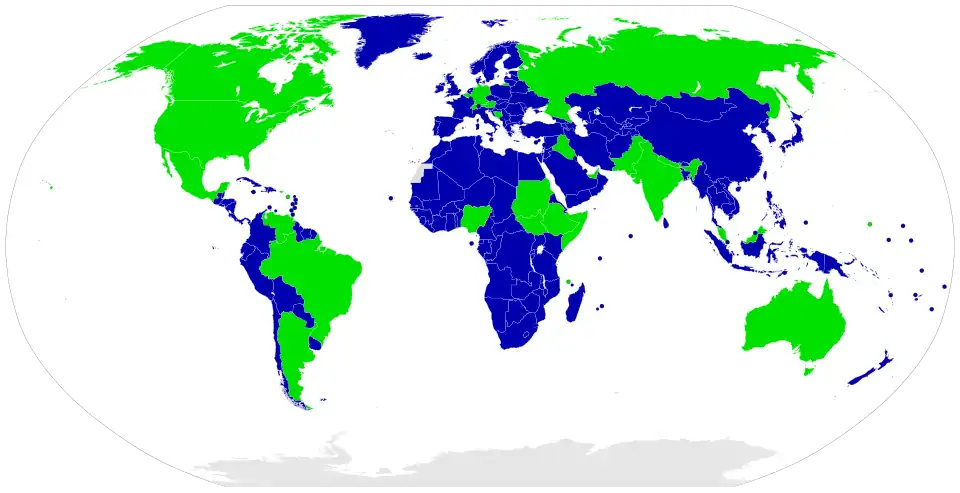 A world map distinguishing countries of the world as federations (green) from unitary states (blue), a work of political science (from Political science)
 -
 World map with the concepts of Heartland and Rimland applied (from Geopolitics)
 -
 The logo and slogan for change.org (from Politics and technology)
 -

-
 Savka Dabčević-Kučar, Croatian Spring participant; Europe's first female prime minister (from Civil and political rights)
 -
 Reformers like the American Joseph Keppler depicted the Senate as controlled by the giant moneybags, who represented the nation's financial trusts and monopolies. (from Political corruption)
 -
 American lobbyist and businessman Jack Abramoff was at the center of an extensive corruption investigation. (from Political corruption)
 -
 Malaysia's former Prime Minister Najib Razak was found guilty in the corruption trial over the multi-billion-dollar 1MDB scandal. He is currently serving his sentence in Kajang Prison. (from Political corruption)
 -
 Detail from Corrupt Legislation (1896) by Elihu Vedder. Library of Congress Thomas Jefferson Building, Washington, D.C. (from Political corruption)
 -
 The Flag of the United Nations flying at United Nations Plaza in the Civic Center, San Francisco, California. The UN is one of the key organizations in the process of the political globalization. (from Political globalization)
 -
 Countries with politicians, public officials or close associates implicated in the Panama Papers leak on April 15, 2016 (from Political corruption)
 -
%252C_%C3%A9crivain_et_homme_politique_-_P1679_-_Mus%C3%A9e_Carnavalet.jpg)
-
 The sixth president of the United States, John Quincy Adams' "corrupt bargain" of 1824 is an example of patronage. (from Political corruption)
 -
 Ferdinand Marcos (pictured with his daughter Imee) was a Philippine dictator and kleptocrat. His regime was infamous for its corruption. (from Political corruption)
 -

-
.jpeg) Candlelight protest against South Korean President Park Geun-hye in Seoul, South Korea, January 2017 (from Political corruption)
Candlelight protest against South Korean President Park Geun-hye in Seoul, South Korea, January 2017 (from Political corruption) -
 This is the divide of the different political parties in Estonia where in the 2013 elections, over 133,000 people (roughly 21.2% of participating voters) voted over the Internet. The 2013 elections were also the first elections to allow vote verification with mobile devices. (from Politics and technology)
 -
 Russia handing over the symbolic relay baton for the hosting rights of the 2022 FIFA World Cup to Qatar in June 2018 (from Political corruption)
 -
_(2).jpg) Protesters in support of American whistleblower Edward Snowden, Berlin, Germany, August 2014 (from Political corruption)
Protesters in support of American whistleblower Edward Snowden, Berlin, Germany, August 2014 (from Political corruption) -
 Eugène Delacroix's Liberty Leading the People (1830, Louvre), a painting created at a time where old and modern political philosophies came into violent conflict. (from History of political thought)
 -

-
 Karl Marx and his theory of Communism, developed with Friedrich Engels, proved to be one of the most influential political ideologies of the 20th century. (from History of political thought)
 -
 Montenegro's former president Milo Đukanović is often described as having strong links to Montenegrin mafia. (from Political corruption)
 -
 Sir Halford Mackinder's Heartland concept showing the situation of the "pivot area" established in the Theory of the Heartland. He later revised it to mark Northern Eurasia as a pivot while keeping area marked above as Heartland. (from Geopolitics)
 -
.jpg) Elizabeth Warren and Bernie Sanders campaigning for extended US Medicare coverage in 2017. (from Health politics)
Elizabeth Warren and Bernie Sanders campaigning for extended US Medicare coverage in 2017. (from Health politics) -
 Division of the world according to Haushofer's pan-regions doctrine (from Geopolitics)
 -
 A memorial to the Great Famine (Ireland), a famine event in Ireland that faced elongated suffering from the UK's domestic policy failures at the time under the Prime Ministers Sir Robert Peel and Lord John Russell. (from Health politics)
Related portals
Associated Wikimedia
The following Wikimedia Foundation sister projects provide more on this subject:
-
 Commons
Free media repository -
 Wikibooks
Free textbooks and manuals -
 Wikidata
Free knowledge base -
Wikinews
Free-content news -
 Wikiquote
Collection of quotations -
 Wikisource
Free-content library -
 Wikiversity
Free learning tools -
 Wiktionary
Dictionary and thesaurus
Sources
More portals
-
 List of all portals
 -

-

-

-

-

-

-

-

-

-
 Random portal
 -
 WikiProject Portals