Portal:Turkey

Merhaba! Türkiye portalına hoş geldiniz. Hi! Welcome to the Turkey portal.
 | |
.svg.png)
| |
Turkey, officially the Republic of Türkiye, is a country mainly located in Anatolia in West Asia, with a smaller part called East Thrace in Southeast Europe. It borders the Black Sea to the north; Georgia, Armenia, Azerbaijan, and Iran to the east; Iraq, Syria, and the Mediterranean Sea to the south; and the Aegean Sea, Greece, and Bulgaria to the west. Turkey is home to over 86 million people; most are ethnic Turks, while Kurds are the largest ethnic minority. Officially a secular state, Turkey has a Muslim-majority population. Ankara is Turkey's capital and second-largest city. Istanbul is its largest city and economic center. Other major cities include İzmir, Bursa, and Antalya.
First inhabited by modern humans during the Late Paleolithic, present-day Turkey was home to various ancient peoples. The Hattians were assimilated by the Hittites and other Anatolian peoples. Classical Anatolia transitioned into cultural Hellenization after Alexander the Great's conquests, and later Romanization during the Roman and Byzantine eras. The Seljuk Turks began migrating into Anatolia in the 11th century, starting the Turkification process. The Seljuk Sultanate of Rum ruled Anatolia until the Mongol invasion in 1243, when it disintegrated into Turkish principalities. Beginning in 1299, the Ottomans united the principalities and expanded. Mehmed II conquered Constantinople (modern-day Istanbul) in 1453. During the reigns of Selim I and Suleiman the Magnificent, the Ottoman Empire became a global power. From 1789 onwards, the empire saw major changes, reforms, centralization, and rising nationalism while its territory declined.
In the 19th and early 20th centuries, persecution of Muslims during the Ottoman contraction and in the Russian Empire resulted in large-scale loss of life and mass migration into modern-day Turkey from the Balkans, Caucasus, and Crimea. Under the control of the Three Pashas, the Ottoman Empire entered World War I in 1914, during which the Ottoman government committed genocides against its Armenian, Greek, and Assyrian subjects. Following Ottoman defeat, the Turkish War of Independence resulted in the abolition of the sultanate and the signing of the Treaty of Lausanne. Turkey emerged as a more homogenous nation state. The Republic was proclaimed on 29 October 1923, modelled on the reforms initiated by its founder and first president, Mustafa Kemal Atatürk. Turkey remained neutral during most of World War II, but was involved in the Korean War. Several military interventions interfered with the transition to a multi-party system.
Turkey is an upper-middle-income and emerging country; its economy is the world's 16th-largest by nominal and 11th-largest by PPP-adjusted GDP. As the 15th-largest electricity producer in the world, Turkey aims to become a hub for regional energy transportation. It is a unitary presidential republic. Turkey is a founding member of the OECD, G20, and Organization of Turkic States. With a geopolitically significant location, Turkey is a NATO member and has its second-largest military force. It may be recognized as an emerging, a middle, and a regional power. As an EU candidate, Turkey is part of the EU Customs Union.
Turkey has coastal plains, a high central plateau, and various mountain ranges with rising elevation eastwards. Turkey's climate is diverse, ranging from Mediterranean and other temperate climates to semi-arid and continental types. Home to three biodiversity hotspots, Turkey is prone to frequent earthquakes and is highly vulnerable to climate change. Turkey has a universal healthcare system, growing access to education, and increasing levels of innovativeness. It is a leading TV content exporter. With numerous UNESCO World Heritage sites and intangible cultural heritage inscriptions, and a rich and diverse cuisine, Turkey is the fourth most visited country in the world. (Full article...)
Selected article -
Turkish literature (Turkish: Türk edebiyatı, Türk yazını) comprises oral compositions and written texts in the Turkish language. The Ottoman form of Turkish, which forms the basis of much of the written corpus, was highly influenced by Persian and Arabic literature, and used the Ottoman Turkish alphabet. The history of the broader Turkic literature spans a period of nearly 1,300 years. The oldest extant records of written Turkic are the Orhon inscriptions, found in the Orhon River valley in central Mongolia and dating to the 7th century. Subsequent to this period, between the 9th and 11th centuries, there arose among the nomadic Turkic peoples of Central Asia a tradition of oral epics, such as the Book of Dede Korkut of the Oghuz Turks— ancestors of the modern Turkish people—and the Epic of Manas of the Kyrgyz people. (Full article...)
General images
-
 Turkish coffee (from Culture of Turkey)
 -

-
 Map of Istanbul by the miniature artist Matrakçı Nasuh (from Culture of Turkey)
 -
.jpg) Originally a church, later a mosque, and now a Grand mosque, the Hagia Sophia in Istanbul was built by the Byzantines in the 6th century. (from History of Turkey)
Originally a church, later a mosque, and now a Grand mosque, the Hagia Sophia in Istanbul was built by the Byzantines in the 6th century. (from History of Turkey) -

-
 Ankara Opera House, designed by Şevki Balmumcu (1933–34) and renovation by Paul Bonatz (1946–47). (from Culture of Turkey)
 -

-
 Map showing events of the first phases of the Greco-Persian Wars (from History of Turkey)
 -

-
 View from Levent district in Istanbul. Istanbul's skyline has changed especially since the early 2000s. (from Culture of Turkey)
 -
 Night view of the Taksim Mosque (from Culture of Turkey)
 -

-
 The sultan of the golden age, Suleiman the Magnificent. (from History of Turkey)
 -

-
 The Ottoman Empire in 1683, at the start of the Great Turkish War (1683–1699) (from History of Turkey)
 -
 Lake Van (from Geography of Turkey)
 -

-
 Istanbul (from Geography of Turkey)
 -

-
 Tevfik Fikret (1867–1915) was a prominent Turkish poet of the late Ottoman era. (from Culture of Turkey)
 -
 Ankara (from Geography of Turkey)
 -
 First Ziraat Bank Headquarters (1925–29) in Ankara designed by Giulio Mongeri is an important symbol of the First National Architectural Movement. (from Culture of Turkey)
 -
 Kaçkar Mountains. (from Geography of Turkey)
 -
.jpg)
-
.jpg) Butterfly Valley on the Turkish Riviera. (from Geography of Turkey)
Butterfly Valley on the Turkish Riviera. (from Geography of Turkey) -
 Recaizade Mahmud Ekrem (1847–1914) was another prominent Turkish poet of the late Ottoman era. (from Culture of Turkey)
 -
 Namık Kemal was a prominent Turkish poet, novelist, playwright and journalist of the late-19th-century Ottoman Empire. (from Culture of Turkey)
 -
 Map of earthquakes in Turkey 1900–2023 (from Geography of Turkey)
 -
 Thrace and the Thracian Odrysian kingdom in its maximum extent under Sitalces (431-424 BC) (from History of Turkey)
 -
_(cropped).jpg)
-

-
 Istanbul Sapphire (2006–11) is the tallest building in Turkey and 4th in Europe. (from Culture of Turkey)
 -

-
 Köppen climate types of Turkey (from Geography of Turkey)
 -
 Sami Frashëri (1850–1904) and his wife Emine, May 1884. (from Culture of Turkey)
 -
 Regions of Roman Anatolia (from History of Turkey)
 -

-
 Turkish delight (from Culture of Turkey)
 -
 Fazıl Hüsnü Dağlarca was one of the most prolific Turkish poets of the Turkish Republic with more than 60 collections of his poems published, laureate of the Struga Poetry Evenings Golden Wreath Award. (from Culture of Turkey)
 -
 Map showing the Anatolian Plate, the North Anatolian Fault and East Anatolian Fault in Turkey. (from Geography of Turkey)
 -
 Turkish national basketball team won the silver medal in the 2010 FIBA World Championship. (from Culture of Turkey)
 -
 Istanbul University Faculty of Science and Faculty of Literature Buildings (1944–52) designed by Sedad Hakkı Eldem and Emin Onat (from Culture of Turkey)
 -
 Mount Ararat (from Geography of Turkey)
 -
 Karagöz and Hacivat are the lead characters of Turkish shadow play, popularized during the Ottoman period. (from Culture of Turkey)
 -
 View of Beydağları Coastal National Park (from Geography of Turkey)
 -

-
 Atatürk on the cover of the Time magazine, Vol. I No. 4, March 24, 1923. Title: "Mustapha Kemal Pasha" (from History of Turkey)
 -
 Roosevelt, İnönü and Churchill at the Second Cairo Conference which was held between 4–6 December 1943. (from History of Turkey)
 -
 Bronze Age Anatolia (from History of Turkey)
 -
 Visit of Kaiser Wilhelm II of Germany to Turkey in October 1917. Together with the Mehmed V and Enver Pasha (from History of Turkey)
 -
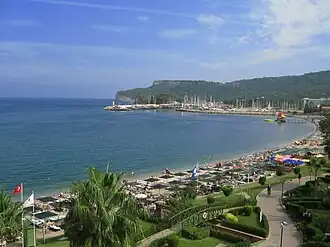
 Antalya (from Geography of Turkey)
 -
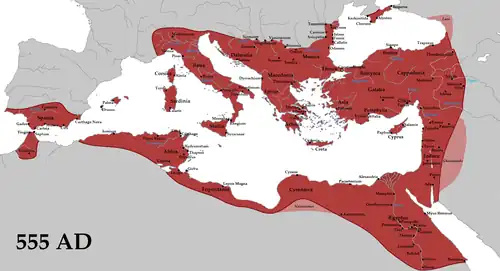 The empire in 555 under Justinian the Great, at its greatest extent since the fall of the Western Roman Empire (its vassals in pink) (from History of Turkey)
 -
-
 Designed by Şekip Akalın, Ankara Central Station (1937) is a notable art deco design of its era. (from Culture of Turkey)
Did you know -
- ... that the Battle of Bapheus in 1302 was the first major Ottoman victory, and led to their gradual conquest of Byzantine-controlled Bithynia? (April 16, 2010)
- ... that Fatma Aliye Topuz (1862-1936), whose portrait illustrates the reverse of the current 50 Turkish lira banknote, is credited as the first female Turkish and Muslim writer? (May 5, 2009) Wikipedia:Recent additions 244
- ... that former Turkish Minister of Customs and Monopolies, Tuncay Mataracı, was sentenced in 1982 to a 36-year term of imprisonment for bribery and abuse of power? (February 24, 2014)
- ... that one of the accused assassins of Turkish former government minister Gün Sazak later hijacked an airplane to Bulgaria with accomplices? (February 21, 2014)
- ... that the Ottoman frigate Ertuğrul disaster, which occurred in 1890 off Kushimoto, led to strengthening foreign relations between Turkey and Japan? (January 16, 2008) Wikipedia:Recent additions 200
- ... that several families of land gastropods reach a maximum of biodiversity in Turkey? (March 3, 2010)
- ... that the Mecelle, the Ottoman civil code of 1877, was the first attempt to codify part of the laws of an Islamic state? (January 7, 2007) Wikipedia:Recent additions 115
Selected picture
-
 the Selimiye Mosque in Edirne
 -
 The Temple of Athena at Priene, an ancient site near Turunçlar in Aydın province.
 -
 Lake Akdoğan in Muş
 -

-
 The ancient Lake Abant Nature Park in Bolu
 -

-

-
 Antalya
 -
 Safranbolu
 -
 Aydilge Sarp; Turkish singer, songwriter and novelist
 -
 Iznik, 16th-century vase
 -
-
.jpg)
-
 1. picture on portal: The prominent towers of Dayro d-Mor Gabriel; 15th December 2005
 -
 the Bosphorus Bridge
 -
 Tarkan with Hungarian fans
 -
 18th-century Ottoman barber's apron
 -
 The tughra of Mahmud II. "Mahmud Han bin Abdulhamid muzaffer daima" ("Mahmud Khan son of Abdulhamid is forever victorious").
 -
 Atatürk praying
 -
 The sun setting over the Golden Horn in the city of Istanbul.
 -

-

-
 A Kocek
 -

-
 Flag of Turkey, from flowers
 -
 A faculty of Sakarya University
 -

Selected biography -

Piri Reis (Turkish: Pîrî Reis; born Muhiddin Piri; c. 1470–1553) was an Ottoman Turkish cartographer, admiral, navigator, and corsair. He is best known for his 1513 world map and his nautical atlas, the Kitab-ı Bahriye (Book of the Sea). His maps combined classical sources, his own seafaring knowledge, and information from new European discoveries. His cartography was more engaged with the Age of Discovery than other Ottoman works from the period.
Piri Reis began his maritime career sailing with his uncle, the corsair Kemal Reis, with whom he entered Ottoman naval service. He later commanded his own ship in the Ottoman–Venetian wars and, following his uncle’s death, began the cartographic work for which he became best known. In 1516, he took part in the conquest of Egypt. He presented his world maps and atlases as gifts to the Ottoman Sultan, and commanded a small group of ships in naval operations in the eastern Mediterranean. Later, as grand admiral of the Ottoman fleet in the Indian Ocean, Piri Reis led successful campaigns in the Red Sea, but was executed following his retreat from the siege of Hormuz Island at the mouth of the Persian Gulf. (Full article...)
Selected video -
Selected quote -
| “ | A satiated man doesn't know what's hunger, a healthy man doesn't know what's disease. | ” |
Recognized content


Provinces


Topics
| History |
| ||||||||||||
|---|---|---|---|---|---|---|---|---|---|---|---|---|---|
| Geography |
| ||||||||||||
| Government |
| ||||||||||||
| Economy | |||||||||||||
| Demographics | |||||||||||||
| Society |
| ||||||||||||


Categories

Related portals
Religions in Turkey
Neighbouring countries
Countries with related heritage
WikiProjects
- European Union WikiProject
- Ottoman military history WikiProject
- Greek and Turkish wikipedians cooperation board
- European history WikiProject
- Eastern Europe WikiProject · Caucasia WikiProject
- Balkan military history WikiProject
- Islam WikiProject
- Countries WikiProject · Western Asia WikiProject
- Ancient Near East WikiProject
- Geography WikiProject
Turkish wikipedia
 |
There is a Turkish version of Wikipedia, the free encyclopedia. |
Wikimedia
The following Wikimedia Foundation sister projects provide more on this subject:
-
 Commons
Free media repository -
 Wikibooks
Free textbooks and manuals -
 Wikidata
Free knowledge base -
 Wikinews
Free-content news -
 Wikiquote
Collection of quotations -
 Wikisource
Free-content library -
 Wikiversity
Free learning tools -
 Wikivoyage
Free travel guide -
 Wiktionary
Dictionary and thesaurus
-
 List of all portals
 -

-

-

-

-

-

-

-

-

-
 Random portal
 -
 WikiProject Portals