Portal:Physics

The Physics Portal


Physics is the scientific study of matter, its fundamental constituents, its motion and behavior through space and time, and the related entities of energy and force. It is one of the most fundamental scientific disciplines. A scientist who specializes in the field of physics is called a physicist.
Physics is one of the oldest academic disciplines. Over much of the past two millennia, physics, chemistry, biology, and certain branches of mathematics were a part of natural philosophy, but during the Scientific Revolution in the 17th century, these natural sciences branched into separate research endeavors. Physics intersects with many interdisciplinary areas of research, such as biophysics and quantum chemistry, and the boundaries of physics are not rigidly defined. New ideas in physics often explain the fundamental mechanisms studied by other sciences and suggest new avenues of research in these and other academic disciplines such as mathematics and philosophy.
Advances in physics often enable new technologies. For example, advances in the understanding of electromagnetism, solid-state physics, and nuclear physics led directly to the development of technologies that have transformed modern society, such as television, computers, domestic appliances, and nuclear weapons; advances in thermodynamics led to the development of industrialization; and advances in mechanics inspired the development of calculus. (Full article...)
 Featured article -

The Hubble Deep Field (HDF) is an image of a small region in the constellation Ursa Major, constructed from a series of observations by the Hubble Space Telescope. It covers an area about 2.6 arcminutes on a side, about one 24-millionth of the whole sky, which is equivalent in angular size to a tennis ball at a distance of 100 metres. The image was assembled from 342 separate exposures taken with the Space Telescope's Wide Field and Planetary Camera 2 over ten consecutive days between December 18 and 28, 1995.
The field is so small that only a few foreground stars in the Milky Way lie within it; thus, almost all of the 3,000 objects in the image are galaxies, some of which are among the youngest and most distant known. By revealing such large numbers of very young galaxies, the HDF has become a landmark image in the study of the early universe. (Full article...)
Did you know -

- ... that Virendra Singh delivered the inaugural Homi Bhabha exchange lecture of the Institute of Physics and Indian Physics Association in 2000?
- ... that Leiden Law School is housed in the former laboratory of Heike Kamerlingh Onnes, a physicist and Nobel laureate?
Selected image -

Related portals
 Good articles -
-

_C.jpg)
Chien-Shiung Wu, after whom the Wu experiment is named, designed the experiment and led the team that carried out the test of the conservation of parity in 1956.
The Wu experiment was a particle and nuclear physics experiment conducted in 1956 by the Chinese-American physicist Chien-Shiung Wu in collaboration with the Low Temperature Group of the US National Bureau of Standards. The experiment's purpose was to establish whether conservation of parity, which was previously established in the electromagnetic and strong interactions, also applied to weak interactions. If parity conservation were universal, particle decays governed by the weak interaction would behave similarly to particle decays involving the other interactions. A parity transformation negates the coordinates in a theory. If the predictions of the theory are not altered, it is said to "conserve parity". A parity transformation creates a mirror image. In mirror images, objects spinning clockwise appear to spin counterclockwise. The Wu experiment created an atomic system with spin, then compared weak-interaction particle decay for spins clockwise and anti-clockwise.
The experiment established that conservation of parity was violated by the weak interaction, thus providing a way to operationally define left and right. This result was not expected by the physics community, which had previously regarded parity as a symmetry that applied to all forces of nature. Tsung-Dao Lee and Chen-Ning Yang, the theoretical physicists who originated the idea of parity nonconservation and proposed the experiment, received the 1957 Nobel Prize in Physics for this result. While not awarded the Nobel Prize, Chien-Shiung Wu's role in the discovery was mentioned in the Nobel Prize acceptance speech of Yang and Lee, but she was not honored until 1978, when she was awarded the first Wolf Prize. (Full article...) -

True-color image of Uranus by Voyager 2
The atmosphere of Uranus is composed primarily of hydrogen and helium. At depth, it is significantly enriched in volatiles (dubbed "ices") such as water, ammonia, and methane. The opposite is true for the upper atmosphere, which contains very few gases heavier than hydrogen and helium due to its low temperature. Uranus's atmosphere is the coldest of all the planets, with its temperature reaching as low as 49 K.
The Uranian atmosphere can be divided into three main layers: the troposphere, between altitudes of −300 and 50 km and pressures from 100 to 0.1 bar; the stratosphere, spanning altitudes between 50 and 4000 km and pressures of between 0.1 and 10−10 bar; and the hot thermosphere (and exosphere) extending from an altitude of 4,000 km to several Uranian radii from the nominal surface at 1 bar pressure. Unlike Earth's, Uranus's atmosphere has no mesosphere. (Full article...) -

Hans Albrecht Eduard Bethe (/ˈbɛθə/; German: [ˈhans ˈbeːtə] ⓘ; July 2, 1906 – March 6, 2005) was a German-American physicist who made major contributions to nuclear physics, astrophysics, quantum electrodynamics and solid-state physics, and received the Nobel Prize in Physics in 1967 for his work on the theory of stellar nucleosynthesis. For most of his career, Bethe was a professor at Cornell University.
In 1931, Bethe developed the Bethe ansatz, which is a method for finding the exact solutions for the eigenvalues and eigenvectors of certain one-dimensional quantum many-body models. In 1939, Bethe published a paper which established the CNO cycle as the primary energy source for heavier stars in the main sequence classification of stars, which earned him a Nobel Prize in 1967. During World War II, Bethe was head of the Theoretical Division at the secret Los Alamos National Laboratory that developed the first atomic bombs. There he played a key role in calculating the critical mass of the weapons and developing the theory behind the implosion method used in both the Trinity test and the "Fat Man" weapon dropped on Nagasaki in August 1945. (Full article...) -

An Andrea Amati violin, which may have been made as early as 1558, making it one of the earliest violins in existence
Violin acoustics is an area of study within musical acoustics concerned with how the sound of a violin is created as the result of interactions between its many parts. These acoustic qualities are similar to those of other members of the violin family, such as the viola.
The energy of a vibrating string is transmitted through the bridge to the body of the violin, which allows the sound to radiate into the surrounding air. Both ends of a violin string are effectively stationary, allowing for the creation of standing waves. A range of simultaneously produced harmonics each affect the timbre, but only the fundamental frequency is heard. The frequency of a note can be raised by the increasing the string's tension, or decreasing its length or mass. The number of harmonics present in the tone can be reduced, for instance by the using the left hand to shorten the string length. The loudness and timbre of each of the strings is not the same, and the material used affects sound quality and ease of articulation. Violin strings were originally made from catgut but are now usually made of steel or a synthetic material. Most strings are wound with metal to increase their mass while avoiding excess thickness. (Full article...) -

Figure 2: The radius r of the green and blue planets are the same, but their angular speed differs by a factor k. Examples of such orbits are shown in Figures 1 and 3–5.
In classical mechanics, Newton's theorem of revolving orbits identifies the type of central force needed to multiply the angular speed of a particle by a factor k without affecting its radial motion (Figures 1 and 2). Newton applied his theorem to understanding the overall rotation of orbits (apsidal precession, Figure 3) that is observed for the Moon and planets. The term "radial motion" signifies the motion towards or away from the center of force, whereas the angular motion is perpendicular to the radial motion.
Isaac Newton derived this theorem in Propositions 43–45 of Book I of his Philosophiæ Naturalis Principia Mathematica, first published in 1687. In Proposition 43, he showed that the added force must be a central force, one whose magnitude depends only upon the distance r between the particle and a point fixed in space (the center). In Proposition 44, he derived a formula for the force, showing that it was an inverse-cube force, one that varies as the inverse cube of r. In Proposition 45 Newton extended his theorem to arbitrary central forces by assuming that the particle moved in nearly circular orbit. (Full article...) -
Chien-Shiung Wu (Chinese: 吳健雄; pinyin: Wú Jiànxióng; Wade–Giles: Wu2 Chien4-Hsiung2; May 31, 1912 – February 16, 1997) was a Chinese-American particle and experimental physicist who made significant contributions in the fields of nuclear and particle physics. Wu worked on the Manhattan Project, where she helped develop the process for separating uranium into uranium-235 and uranium-238 isotopes by gaseous diffusion. She is best known for conducting the Wu experiment, which proved that parity is not conserved. This discovery resulted in her colleagues Tsung-Dao Lee and Chen-Ning Yang winning the 1957 Nobel Prize in Physics, while Wu herself was awarded the inaugural Wolf Prize in Physics in 1978. Her expertise in experimental physics evoked comparisons to Marie Curie. Her nicknames include the "First Lady of Physics", the "Chinese Marie Curie" and the "Queen of Nuclear Research". (Full article...) -
James Clerk Maxwell FRS FRSE (13 June 1831 – 5 November 1879) was a Scottish physicist and mathematician who was responsible for the classical theory of electromagnetic radiation, which was the first theory to describe electricity, magnetism and light as different manifestations of the same phenomenon. Maxwell's equations for electromagnetism achieved the second great unification in physics, where the first one had been realised by Isaac Newton. Maxwell was also key in the creation of statistical mechanics.
Maxwell graduated from Trinity College, Cambridge, in 1854, where he earned distinction in mathematics and the Smith’s Prize. He remained at Cambridge briefly, publishing early mathematical work and investigations into optics, particularly the principles of colour combination and colour-blindness. He later held the Chair of Natural Philosophy at Marischal College, where he studied the rings of Saturn and correctly proposed that they were composed of numerous small particles, work that earned him the Adams Prize in 1859. During this time he married Katherine Mary Dewar, who assisted him in his laboratory work. From 1860 to 1865, he served as the Professor of Natural Philosophy at King’s College London, where he developed his theory of electromagnetic fields. His publication of "A Dynamical Theory of the Electromagnetic Field" in 1865 demonstrated that electric and magnetic fields travel through space as waves moving at the speed of light, proposing that light is an undulation in the same medium that is the cause of electric and magnetic phenomena. His unification of light and electrical phenomena led to his prediction of the existence of radio waves. (Full article...) -
Ernest Orlando Lawrence (August 8, 1901 – August 27, 1958) was an American accelerator physicist who received the Nobel Prize in Physics in 1939 for his invention of the cyclotron. He is known for his work on uranium-isotope separation for the Manhattan Project, as well as for founding the Lawrence Berkeley National Laboratory and the Lawrence Livermore National Laboratory.
A graduate of the University of South Dakota and University of Minnesota, Lawrence obtained a PhD in physics at Yale in 1925. In 1928, he was hired as an associate professor of physics at the University of California, Berkeley, becoming the youngest full professor there two years later. In its library one evening, Lawrence was intrigued by a diagram of an accelerator that produced high-energy particles. He contemplated how it could be made compact, and came up with an idea for a circular accelerating chamber between the poles of an electromagnet. The result was the first cyclotron. (Full article...) -

Decision tree for shapes of particles, adapted from Boukouvala, Daniel and Ringe
Extended Wulff constructions refers to a number of different ways to model the structure of nanoparticles as well as larger mineral crystals. They can be used to understand the shape of gemstones and crystals with twins, and in other areas such as understanding both the shape and how nanoparticles play a role in the commercial production of chemicals using heterogeneous catalysts. Extended Wulff constructions are variants of the Wulff construction, which is used for a solid single crystal in isolation. They include cases for solid particles on substrates, those with internal boundaries and also when growth is important. Depending upon whether there are twins or a substrate, there are different cases as indicated in the decision tree figure. The simplest forms of these constructions yield the lowest Gibbs free energy (thermodynamic) shape, or the stable growth form for an isolated particle; it can be difficult to differentiate between the two in experimental data. The thermodynamic cases involve the surface energy of different facets; the term surface tension refers to liquids, not solids. The shapes found due to growth kinetics involve the growth velocity of the different surface facets. (Full article...) -
Sir Rudolf Ernst Peierls, CBE FRS (/ˈpaɪ.ərlz/; German: [ˈpaɪɐls]; 5 June 1907 – 19 September 1995) was a German-born British physicist who played a major role in Tube Alloys, Britain's nuclear weapon programme, as well as the subsequent Manhattan Project, the combined Allied nuclear bomb programme. His 1996 obituary in Physics Today described him as "a major player in the drama of the eruption of nuclear physics into world affairs".
Peierls studied physics at the University of Berlin, at the University of Munich under Arnold Sommerfeld, the University of Leipzig under Werner Heisenberg, and ETH Zurich under Wolfgang Pauli. After receiving his DPhil from Leipzig in 1929, he became an assistant to Pauli in Zurich. In 1932, he was awarded a Rockefeller Fellowship, which he used to study in Rome under Enrico Fermi, and then at the Cavendish Laboratory at the University of Cambridge under Ralph H. Fowler. Because of his Jewish background, he elected to not return home after Adolf Hitler's rise to power in 1933, but to remain in Britain, where he worked with Hans Bethe at the Victoria University of Manchester, then at the Mond Laboratory at Cambridge. In 1937, Mark Oliphant, the newly appointed Australian professor of physics at the University of Birmingham recruited him for a new chair there in applied mathematics. (Full article...) -

The Leibstadt Nuclear Power Plant in Switzerland
Nuclear power is the use of nuclear reactions to produce electricity. Nuclear power can be obtained from nuclear fission, nuclear decay and nuclear fusion reactions. Presently, the vast majority of electricity from nuclear power is produced by nuclear fission of uranium and plutonium in nuclear power plants. Nuclear decay processes are used in niche applications such as radioisotope thermoelectric generators in some space probes such as Voyager 2. Reactors producing controlled fusion power have been operated since 1958 but have yet to generate net power and are not expected to be commercially available in the near future.
The first nuclear power plant was built in the 1950s. The global installed nuclear capacity grew to 100 GW in the late 1970s, and then expanded during the 1980s, reaching 300 GW by 1990. The 1979 Three Mile Island accident in the United States and the 1986 Chernobyl disaster in the Soviet Union resulted in increased regulation and public opposition to nuclear power plants. Nuclear power plants supplied 2,602 terawatt hours (TWh) of electricity in 2023, equivalent to about 9% of global electricity generation, and were the second largest low-carbon power source after hydroelectricity. As of November 2025, there are 416 civilian fission reactors in the world, with overall capacity of 376 GW, 63 under construction and 87 planned, with a combined capacity of 66 GW and 84 GW, respectively. The United States has the largest fleet of nuclear reactors, generating almost 800 TWh per year with an average capacity factor of 92%. The average global capacity factor is 89%. Most new reactors under construction are generation III reactors in Asia. (Full article...) -
Katharine "Kay" Way (February 20, 1902 – December 9, 1995) was an American physicist best known for her work on the Nuclear Data Project. During World War II, she worked for the Manhattan Project at the Metallurgical Laboratory in Chicago. She became an adjunct professor at Duke University in 1968. (Full article...)
-
The mobility analogy, also called admittance analogy or Firestone analogy, is a method of representing a mechanical system by an analogous electrical system. The advantage of doing this is that there is a large body of theory and analysis techniques concerning complex electrical systems, especially in the field of filters. By converting to an electrical representation, these tools in the electrical domain can be directly applied to a mechanical system without modification. A further advantage occurs in electromechanical systems: Converting the mechanical part of such a system into the electrical domain allows the entire system to be analysed as a unified whole.
The mathematical behaviour of the simulated electrical system is identical to the mathematical behaviour of the represented mechanical system. Each element in the electrical domain has a corresponding element in the mechanical domain with an analogous constitutive equation. All laws of circuit analysis, such as Kirchhoff's laws, that apply in the electrical domain also apply to the mechanical mobility analogy. (Full article...) -
Johann Carl Friedrich Gauss (/ɡaʊs/ ⓘ; German: Gauß; [kaʁl ˈfʁiːdʁɪç ˈɡaʊs] ⓘ; Latin: Carolus Fridericus Gauss; 30 April 1777 – 23 February 1855) was a German mathematician, astronomer, geodesist, and physicist, who contributed to many fields in mathematics and science. His mathematical contributions spanned the branches of number theory, algebra, analysis, geometry, statistics, and probability. Gauss was director of the Göttingen Observatory in Germany and professor of astronomy from 1807 until his death in 1855.
From an early age, Gauss was known as a child prodigy in mathematics. While studying at the University of Göttingen, he propounded several mathematical theorems. As an independent scholar, he wrote the masterpieces Disquisitiones Arithmeticae and Theoria motus corporum coelestium. Gauss produced the second and third complete proofs of the fundamental theorem of algebra. He also introduced the triple bar symbol (≡) for congruence. In number theory, he made numerous contributions, such as the composition law, the law of quadratic reciprocity, and proved the triangular case of the Fermat polygonal number theorem. He also contributed to the theory of binary and ternary quadratic forms, and the theory of hypergeometric series. When Gauss was only 19 years old, he proved the construction of the heptadecagon, the first progress in regular polygon construction in over 2000 years. He also introduced the concept of Gaussian curvature and proved its key properties, especially with his Theorema Egregium. Gauss was the first to prove Gauss's inequality. Further, he was instrumental in the development of the arithmetic–geometric mean. Due to Gauss's extensive and fundamental contributions to science and mathematics, more than 100 mathematical and scientific concepts are named after him. (Full article...) -
John Tucker "Chick" Hayward (15 November 1908 – 23 May 1999) was an American naval aviator during World War II. He helped develop one of the two atomic bombs that was dropped on Japan in the closing days of the war. Later, he was a pioneer in the development of nuclear propulsion, nuclear weapons, guidance systems for ground- and air-launched rockets, and underwater anti-submarine weapons. A former batboy for the New York Yankees, Hayward dropped out of high school and lied about his age to enlist in the United States Navy at age 16. He was subsequently admitted to the United States Naval Academy at Annapolis, from which he graduated 51st in his class of 1930. He volunteered for naval aviation.
During World War II, he served at the Naval Aircraft Factory in Philadelphia, where he was involved in an effort to improve aircraft instrumentation, notably the compass and altimeter. He attended the University of Pennsylvania's Moore School of Electrical Engineering, and studied nuclear physics. In June 1942, he assumed command of a new patrol bomber squadron, VB-106, equipped with PB4Y-1 Liberators, which he led in a daring raid on Wake Island, in the Solomon Islands campaign, and in the Southwest Pacific Area. Returning to the United States in 1944, he was posted to the Naval Ordnance Test Station at Inyokern, California, where he joined the Manhattan Project, participating in Project Camel, the development of the non-nuclear components of the Fat Man bomb, and in its drop testing. (Full article...)


February anniversaries
- 15 February 1564 – Galileo Galilei's birthday
- 18 February 1745 – Alessandro Volta's birthday
- 15 February 1786 – Cat's Eye Nebula discovered
- 18 February 1838 – Ernst Mach's birthday
- 11 February 1847 – Thomas Edison's birthday
- 23 February 1855 – Carl Friedrich Gauss's death
- 22 February 1875 – Heinrich Hertz's birthday
- 28 February 1901 – Linus Pauling's birthday
- 18 February 1967 – J. Robert Oppenheimer's death
- 13 February 1910 – William Shockley's birthday
- 15 February 1988 – Richard Feynman's death
- 28 February 2020 – Freeman Dyson's death
General images
-
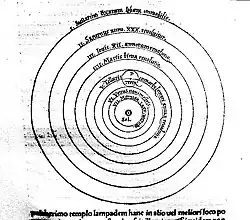
-
 Christiaan Huygens (1629–1695) (from History of physics)
 -

-
 The Hindu-Arabic numeral system. The inscriptions on the edicts of Ashoka (3rd century BCE) display this number system being used by the Imperial Mauryas. (from History of physics)
 -
 Classical physics is usually concerned with everyday conditions: speeds are much lower than the speed of light, sizes are much greater than that of atoms, yet very small in astronomical terms. Modern physics, however, is concerned with high velocities, small distances, and very large energies. (from Modern physics)
 -
 Hydrogen emission spectrum is discrete (here in log scale). The lines can only be explained with quantum mechanics. (from History of physics)
 -

-
 The Standard Model (from History of physics)
 -
 Marie Skłodowska-Curie
(1867–1934) received Nobel prizes in physics (1903) and chemistry (1911). (from History of physics) -
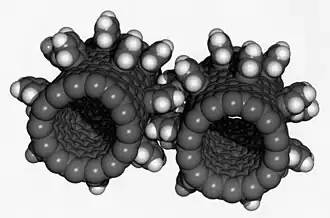 Computer simulation of nanogears made of fullerene molecules. It is hoped that advances in nanoscience will lead to machines working on the molecular scale. (from Condensed matter physics)
 -

-
 Heike Kamerlingh Onnes and Johannes van der Waals with the helium liquefactor at Leiden in 1908 (from Condensed matter physics)
 -
 The Voltaic pile, the first battery was invented by Alessandro Volta in 1800 (from History of physics)
 -
 A magnet levitating above a high-temperature superconductor. Today some physicists are working to understand high-temperature superconductivity using the AdS/CFT correspondence. (from Condensed matter physics)
 -
 Magdeburg hemispheres, an experiment by Otto von Guericke where two metal hemispheres are held together by vacuum and cannot be separated even if large forces are applied. (from History of physics)
 -
 An engraving of Benjamin Franklin's kite experiment used to study lightning. (from History of physics)
 -
.png) Johannes Kepler's first law of planetary motion states that planets move in elliptical orbits about the Sun. (from History of physics)
Johannes Kepler's first law of planetary motion states that planets move in elliptical orbits about the Sun. (from History of physics) -
 Crookes tube used to study cathode rays. It led to the discovery of the electron by J. J. Thomson. (from History of physics)
 -
.png) Composite montage comparing Jupiter (left) and its four Galilean moons (from top: Io, Europa, Ganymede, Callisto) (from History of physics)
Composite montage comparing Jupiter (left) and its four Galilean moons (from top: Io, Europa, Ganymede, Callisto) (from History of physics) -
 A Feynman diagram representing (left to right) the production of a photon (blue sine wave) from the annihilation of an electron and its complementary antiparticle, the positron. The photon becomes a quark–antiquark pair and a gluon (green spiral) is released. (from History of physics)
 -
.png) James Prescott Joule's apparatus for measuring the mechanical equivalent of heat which the "work" of the falling weight is converted into the "heat" of agitation in the water. (from History of physics)
James Prescott Joule's apparatus for measuring the mechanical equivalent of heat which the "work" of the falling weight is converted into the "heat" of agitation in the water. (from History of physics) -
 Einstein proposed that gravitation results from masses (or their equivalent energies) curving ("bending") the spacetime in which they exist, altering the paths they follow within it. (from History of physics)
 -
 Newton's cannonball, a though experiment by Newton relating the motion of a projectile and orbiting of planets. (from History of physics)
 -
 Albert Einstein (1879–1955), ca. 1905 (from History of physics)
 -
 Richard Feynman's Los Alamos ID badge (from History of physics)
 -

-
 The ancient Greek mathematician Archimedes, developer of ideas regarding fluid mechanics and buoyancy. (from History of physics)
 -
 Galileo Galilei (1564–1642), early proponent of the modern scientific worldview and method (from History of physics)
 -
_in_1958.jpg) Chien-Shiung Wu worked on parity violation in 1956 and announced her results in January 1957. (from History of physics)
Chien-Shiung Wu worked on parity violation in 1956 and announced her results in January 1957. (from History of physics) -

-
 Star maps by the 11th century Chinese polymath Su Song are the oldest known woodblock-printed star maps to have survived to the present day. This example, dated 1092, employs the cylindricalequirectangular projection. (from History of physics)
 -
 One possible signature of a Higgs boson from a simulated proton–proton collision. It decays almost immediately into two jets of hadrons and two electrons, visible as lines. (from History of physics)
 -
 The quantum Hall effect: Components of the Hall resistivity as a function of the external magnetic field (from Condensed matter physics)
 -
 Image of X-ray diffraction pattern from a protein crystal (from Condensed matter physics)
 -
 Classical physics (Rayleigh–Jeans law, black line) failed to explain black-body radiation – the so-called ultraviolet catastrophe. The quantum description (Planck's law, colored lines) is said to be modern physics. (from Modern physics)
 -
 The first Bose–Einstein condensate observed in a gas of ultracold rubidium atoms. The blue and white areas represent higher density. (from Condensed matter physics)
 -
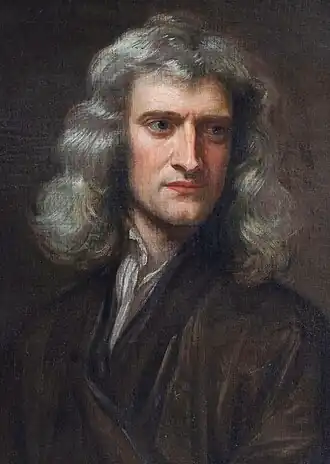 Sir Isaac Newton (1642–1727) (from History of physics)
 -

-
 Maxwell's demon, thought experiment by James Clerk Maxwell to describe the kinetic theory of gases and describe how a microscopic creature could lead to violations of the second law of thermodynamics. (from History of physics)
 -
 1927 Solvay Conference included prominent physicists Albert Einstein, Werner Heisenberg, Max Planck, Hendrik Lorentz, Niels Bohr, Marie Curie, Erwin Schrödinger, Paul Dirac (from History of physics)
Categories

Fundamentals: Concepts in physics | Constants | Physical quantities | Units of measure | Mass | Length | Time | Space | Energy | Matter | Force | Gravity | Electricity | Magnetism | Waves
Basic physics: Mechanics | Electromagnetism | Statistical mechanics | Thermodynamics | Quantum mechanics | Theory of relativity | Optics | Acoustics
Specific fields: Acoustics | Astrophysics | Atomic physics | Molecular physics | Optical physics | Computational physics | Condensed matter physics | Nuclear physics | Particle physics | Plasma physics
Tools: Detectors | Interferometry | Measurement | Radiometry | Spectroscopy | Transducers
Background: Physicists | History of physics | Philosophy of physics | Physics education | Physics journals | Physics organizations
Other: Fiction about physics | Physics lists | Physics software | Physics stubs
Physics topics
Classical physics traditionally includes the fields of mechanics, optics, electricity, magnetism, acoustics and thermodynamics. The term Modern physics is normally used for fields which rely heavily on quantum theory, including quantum mechanics, atomic physics, nuclear physics, particle physics and condensed matter physics. General and special relativity are usually considered to be part of modern physics as well.
More recognized content

Associated Wikimedia
The following Wikimedia Foundation sister projects provide more on this subject:
-
 Commons
Free media repository -
 Wikibooks
Free textbooks and manuals -
 Wikidata
Free knowledge base -
 Wikinews
Free-content news -
 Wikiquote
Collection of quotations -
 Wikisource
Free-content library -
 Wikiversity
Free learning tools -
 Wikivoyage
Free travel guide -
 Wiktionary
Dictionary and thesaurus
Sources
Portals on Wikipedia
-
 List of all portals
 -

-

-

-

-

-
-

-

-

-
 Random portal
 -
 WikiProject Portals