Portal:New Guinea

The New Guinea Portal
Introduction
Native name: Papua, Niugini, Niu Gini | |
|---|---|
 | |
| Geography | |
| Location | Oceania (Melanesia) |
| Archipelago | Melanesia and Malay Archipelago |
| Area | 785,753 km2 (303,381 sq mi) |
| Area rank | 2nd |

New Guinea (Tok Pisin: Niugini; Hiri Motu: Niu Gini; Indonesian: Papua, fossilized Nugini, also known as Papua or historically Irian) is the world's second-largest island, with an area of 785,753 km2 (303,381 sq mi). It has the third-largest remaining rainforest globally, and the highest plant biodiversity of any island. Located in Melanesia in the southwestern Pacific Ocean, the island is separated from Australia by the 150-kilometre (81-nautical-mile; 93-mile) wide Torres Strait, though both landmasses lie on the same continental shelf, and were united during episodes of low sea level in the Pleistocene glaciations as the combined landmass of Sahul. Numerous smaller islands are located to the west and east. The island's name was given by Spanish explorer Yñigo Ortiz de Retez during his maritime expedition of 1545 because of the perceived resemblance of the indigenous peoples of the island to those in the African region of Guinea. (Full article...)
Papua New Guinea (PNG), officially the Independent State of Papua New Guinea, is an island country in Oceania that comprises the eastern half of the island of New Guinea and offshore islands in Melanesia, a region of the southwestern Pacific Ocean north of Australia. It has a land border with Indonesia to the west and maritime borders with Australia to the south and the Solomon Islands to the east. Its capital is Port Moresby. The country's 462,840 km2 (178,700 mi2) includes a large mainland and hundreds of islands. (Full article...)
Western New Guinea, also known as Papua, Indonesian New Guinea, and Indonesian Papua, is the western half of the island of New Guinea, formerly Dutch and granted to Indonesia in 1962. Given the island is alternatively named Papua, the region is also called West Papua (Indonesian: Papua Barat). It is one of the seven geographical units of Indonesia in ISO 3166-2:ID. (Full article...)
Selected article -
-


The geography of Papua New Guinea describes the eastern half of the island of New Guinea, the islands of New Ireland, New Britain and Bougainville, and smaller nearby islands. Together these make up the nation of Papua New Guinea in tropical Oceania, located in the western edge of the Pacific Ocean.
Papua New Guinea is largely mountainous, and much of it is covered with tropical rainforest. The New Guinea Highlands (or Central Range) run the length of New Guinea, and the highest areas receive snowfall—a rarity in the tropics. Within Papua New Guinea Mount Wilhelm is the highest peak, at 4,509 m (14,793 ft). There are several major rivers, notably the Sepik River, which is 1,126 km (700 mi) long, which winds through lowland swamp plains to the north coast, and the Fly River at 1,050 km (650 mi) in length, which flows through one of the largest swamplands in the world to the south coast. The Highlands consist of a number of smaller ranges running west to east, such as the Finisterre Range which dominates the Huon Peninsula to the north of the city of Lae. At 462,840 km2 (178,700 mi2) it is the world's third largest island country.
Papua New Guinea has one land border—that which divides the island of New Guinea. Across the 820 km (509 mi) border is the Indonesian provinces of Papua, Highland Papua and South Papua. Papua New Guinea's border with Indonesia is not straight; the border loops slightly to the west along the Fly River in the south-central part of New Guinea, on the western edge of Papua New Guinea's Western Province. There are maritime borders with Australia to the south and Solomon Islands to the southeast. (Full article...) -
New Guinea Force was a military command unit for Australian, United States and native troops from the Territories of Papua and New Guinea serving in the New Guinea campaign during World War II. Formed in April 1942, when the Australian First Army was formed from the Australian I Corps after it returned from the Middle East, it was responsible for planning and directing all operations within the territory up until October 1944. General Headquarters Southwest Pacific Area Operational Instruction No.7 of 25 May 1942, issued by Commander-Allied-Forces, General Douglas MacArthur, placed all Australian and US Army, Air Force and Navy Forces in the Port Moresby Area under the control of New Guinea Force. Over the course of its existence, New Guinea Force was commanded by some of the Australian Army's most notable commanders, including Sydney Rowell, Sir Edmund Herring and Sir Leslie Morshead.
General Sir Thomas Blamey also commanded the force in 1942 while based in Port Moresby. (Full article...) -
Sir Michael Thomas Somare GCL GCMG CH CF SSI KStJ KSG PC (9 April 1936 – 25 February 2021) was a Papua New Guinean politician. Widely called the "father of the nation" (Tok Pisin: Papa blo kantri), he was the first Prime Minister after independence. At the time of his death, Somare was also the longest-serving prime minister, having been in office for 17 years over three separate terms: from 1975 to 1980; from 1982 to 1985; and from 2002 to 2011. His political career spanned from 1968 until his retirement in 2017. Besides serving as PM, he was minister of foreign affairs, leader of the opposition and governor of East Sepik Province.
He served in a variety of positions. His base was not primarily in political parties but in East Sepik Province, the area that elected him. During his political career he was a member of the House of Assembly and after independence in 1975 the National parliament for the East Sepik Provincial – later open – seat. He was the first chief minister at the end of colonial rule. Thereafter he became the first Prime Minister after independence from 1975 to 1980. He returned to the office of Prime Minister from 1982 to 1985, and his longest stint in the position was from 2002 to 2011. He also served as Cabinet Minister: he was minister of foreign affairs from 1988 to 1992; from 1999 to 2001 he was subsequently minister of foreign affairs, minister of mining and Bougainville, minister of foreign affairs and Bougainville affairs. He was leader of the opposition from 1968 to 1972, from 1980 to 1982, and thereafter in that position from 1985 to 1988, from 1992 to 1993, and finally from 2001 to 2002. When the new position of political governor as head of the provincial administration and representative MP was created in 1995, Somare took up the job. He was governor of East Sepik from 1995 until 1999. After the last election that he contended, he again became Governor of East Sepik (2012–2016). He was a founding member of the Pangu Party which led PNG into independence in 1975. He resigned from the Pangu Party and became an independent in 1988. He rejoined the Pangu Party in 1994 but was sacked as a leader in the following year. He was then asked to join and lead the National Alliance Party. In 2017 he left politics and also the National Alliance Party.
While Somare was in March 2011 hospitalised in Singapore, a majority of parliamentarians declared the post of Prime Minister vacant. Peter O'Neill was the new prime minister. This was contested. On 12 December 2011, the Supreme Court of Papua New Guinea ordered that Somare be reinstated as Prime Minister, ruling that O'Neill had not been lawfully appointed. This event triggered the 2011–12 Papua New Guinean constitutional crisis. Following a decisive victory for O'Neill in the 2012 general election, Somare expressed support for him, thereby ending the crisis and forming a coalition government. However, this truce did not last. When Somare announced his departure from politics, he made a blistering attack on O'Neill. (Full article...) -
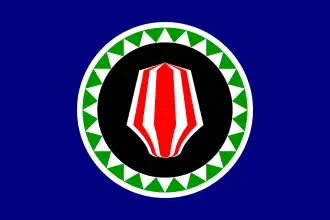
Bougainville (/ˈboʊɡənvɪl/ BOH-gən-vil; Tok Pisin: Bogenvil), officially the Autonomous Region of Bougainville (Tok Pisin: Otonomos Region bilong Bogenvil), is an autonomous region in Papua New Guinea. The largest island is Bougainville Island, while the region also includes Buka Island and a number of outlying islands and atolls. The provisional capital is Buka, on Buka Island.
In 2024, the region had a population of 367,093 people. The lingua franca of Bougainville is Tok Pisin, while a variety of Austronesian and non-Austronesian languages are also spoken. The region includes several Polynesian outliers where Polynesian languages are spoken. Geographically, the islands of Bougainville and Buka form part of the Solomon Islands archipelago, but they are politically separate from the independent country of Solomon Islands. Historically, Bougainville and Buka, together with the islands of Choiseul, Santa Isabel, the Shortlands, and Ontong Java, which are all now part of the country of Solomon Islands, formed the German Solomon Islands Protectorate, the geographical area later being referred to as the North Solomon Islands.
Bougainville has been inhabited by humans for at least 29,000 years. During the colonial period, the region was occupied and administered by the Germans, Australians, Japanese, and Americans for various periods. The name of the region originates from French admiral Louis Antoine de Bougainville, who reached it in 1768. (Full article...) -
The New Guinea Air Warning Wireless, also known as the "New Guinea Air Warning Wireless Company", "NGAWW", or "The Spotters", was a unique signals unit of the Australian Army formed in January 1942 in Port Moresby, Territory of Papua, during World War II, to provide early warning of Japanese air attack, and subsequently providing surveillance of shipping and ground-based troops. During the first month of operations 16 stations were established, with positions set up along the Papuan coast as well as in the mountains near Port Moresby. They often operated behind Japanese lines and were at risk of being captured by the Japanese due to the nature of their operations, while a number of outstations were over-run and the men manning them killed. By the end of 1942 the company was maintaining 61 operational stations and had a strength of 180 men.
Eventually, at its peak in late 1944 there were more than 150 spotter stations deployed on islands and mainland territories throughout Papua, New Guinea and Dutch New Guinea. The company's headquarters moved to Nadzab in June 1944, by which time stations had been established as far as Hollandia. However, in September 1944 the Australian military decided that it would not agree to American requests for the unit to serve outside the Australian area of operations and it was subsequently withdrawn after being left without a future operational role. Returning to Australia, it was disbanded in April 1945. Many of its members received awards for their actions, with the company having the distinction of being Australia's most highly decorated signals unit of World War II. (Full article...) -
The People's National Congress is a political party in Papua New Guinea. Its former leader Bill Skate served as prime minister from 1997 to 1999 and as speaker of Parliament from 2002 to 2004. Skate died in 2006 and the party was led by Peter O'Neill until 2022. PNC originated from the National Capital District where former leader (late Bill Skate) was the Governor of NCD and the Parliamentary Member. The party had 16 members in the 113-seat National Parliament of Papua New Guinea as of December 2022. (Full article...)
-
PNG Football Stadium, known by the sponsored name of Santos National Football Stadium and previously as Lloyd Robson Oval until 2015, is a sporting ground in Port Moresby, Papua New Guinea. It hosted three games for the 1989–1992 Rugby League World Cup. It has been the home ground for the Papua New Guinea national rugby league team since 1975. It has a total capacity of approximately 15,000 and is the National Stadium of Papua New Guinea. The stadium was completely redeveloped in preparation for the 2015 Pacific Games. (Full article...) -
The Landing at Nadzab was an airborne landing on 5 September 1943 during the New Guinea campaign of World War II in conjunction with the landing at Lae. The Nadzab action began with a parachute drop at Lae Nadzab Airport, combined with an overland force.
The parachute drop was carried out by the US Army's 503rd Parachute Infantry Regiment and elements of the Australian Army's 2/4th Field Regiment into Nadzab, New Guinea in the Markham Valley, observed by General Douglas MacArthur, circling overhead in a B-17. The Australian 2/2nd Pioneer Battalion, 2/6th Field Company, and B Company, Papuan Infantry Battalion reached Nadzab after an overland and river trek that same day and began preparing the airfield. The first transport aircraft landed the next morning, but bad weather delayed the Allied build up. Over the next days, the 25th Infantry Brigade of the Australian 7th Division gradually arrived. An air crash at Jackson's Field ultimately caused half the Allied casualties of the battle.
Once assembled at Nadzab, the 25th Infantry Brigade commenced its advance on Lae. On 11 September, it engaged the Japanese soldiers at Jensen's Plantation. After defeating them, it engaged and defeated a larger Japanese force at Heath's Plantation. During this skirmish, Private Richard Kelliher won the Victoria Cross, Australia's highest award for gallantry. Instead of fighting for Lae, the Japanese Army withdrew over the Saruwaged Range. This proved to be a gruelling test of endurance for the Japanese soldiers who had to struggle over the rugged mountains; in the end, the Japanese Army managed to withdraw its forces from Salamaua and Lae, though with extensive losses from exposure and starvation during the retreat. Troops of the 25th Infantry Brigade reached Lae shortly before those of the 9th Division that had been advancing on Lae from the opposite direction. (Full article...) -
The Sulu Range is a small volcanic mountain range on the Papua New Guinean island of New Britain. It consists of a group of partially overlapping small stratovolcanoes and lava domes, with the highest point being 610 m (2,000 ft) Mount Malopu at the southwestern end of the range. Kaiamu, a maar at the northwestern end of the Sulu Range, forms a peninsula with a small lake extending about 1 km (0.62 mi) into Bangula Bay. Other volcanoes in the range include Mount Ululu, Mount Ruckenberg, Mount Talutu and Mount Ubia.
The Sulu Range consists of volcanic rocks ranging in composition from basaltic-to-rhyolitic. Eruptions are not known to have occurred from the range in recorded history, although some of the cones are relatively undissected, implying that there may have been eruptions throughout the Holocene. Volcanic unrest in 2006 resulted in the creation of a vigorous new fumarolic vent, which was preceded by vegetation die-off, seismicity and dust-producing landslides.
On the coastal plain west of the southwest base of the Sulu Range lies the Walo hydrothermal area, which consists of solfataras and mudpots. The fumaroles in this hydrothermal area have been used by locals for cooking food. (Full article...) -
The Bird's Head Peninsula (Indonesian: Kepala Burung, Dutch: Vogelkop, meaning Bird's Head in Indonesian and Dutch) or Doberai Peninsula (Indonesian: Semenanjung Doberai) is a large peninsula that makes up the northwest portion of the island of New Guinea, comprising the Indonesian provinces of Southwest Papua and West Papua. It is often referred to as The Vogelkop, and is so named because its shape looks like a bird's head on the island of New Guinea. The peninsula at the opposite end of the island (in Papua New Guinea) is called the Bird's Tail Peninsula. The peninsula just to the south is called the Bomberai Peninsula. (Full article...) -
The Royal Pacific Islands Regiment (RPIR) is an infantry regiment of the Papua New Guinea Defence Force (PNGDF). The regiment is descended from the Australian Army infantry battalions formed from native soldiers and Australian officers and non-commissioned officers in the territories of Papua and New Guinea during World War II to help fight against the Japanese. Disbanded after the war, the regiment was re-raised in 1951 as part of the Australian Army and continued to serve until Papua New Guinea gained its independence in 1975, when it became part of the PNGDF. Today, the RPIR consists of two battalions and has seen active service in Vanuatu, Bougainville and the Solomon Islands. (Full article...)
-

Vogelkop Peninsula, West Papua (Indonesia)
Bomberai Peninsula (Indonesian: Semenanjung Bomberai) is located in the Western New Guinea region. It is south of the Bird's Head Peninsula, and Bintuni Bay separates the two peninsulas. To the west lies the Sebakor Bay and to the south Kamrau Bay. On the southeast Arguni Bay lies between the peninsula and the Bird's Neck Isthmus.
Sabuda island lies off the western tip of the peninsula, and is separated from the mainland by Berau and Bintuni straits. (Full article...) -
The Porgera Gold Mine is a large gold and silver mining operation near Porgera, Enga province, Papua New Guinea (PNG). Located at the head of the Porgera Valley, The mine is situated in the rain forest covered highlands at an altitude of 2,200 to 2,700 m, in a region of high rainfall, landslides, and frequent earthquakes.
The Porgera Gold Mine closed in April 2020, following the end of its special mining lease. Extensive negotiations for a new special mining lease were concluded in 2023 and the reopening of the mine was announced in December 2023, with first production expected in the first quarter of 2024.
The new special mining lease was finally issued to New Porgera Limited, an entity 51% owned by PNG stakeholders (including state-owned Kumul Minerals Holdings Limited, local landowners and the Enga provincial government), and 49% by Barrick Niugini Limited (BNL), itself a joint venture between Barrick Gold and Zijin Mining of China. (Full article...) -
Severe Tropical Cyclone Rewa affected six countries and caused 22 deaths on its 28-day journey across the South Pacific Ocean in December 1993 and January 1994. Cyclone Rewa developed from a tropical disturbance on 28 December south of Nauru. After forming, Rewa moved southwest through the Solomon Islands, crossing the 160th meridian east from the South Pacific basin into the Australian region. The cyclone began to strengthen steadily and turned southward, paralleling the eastern Australian coast through 31 December. Rewa reached its initial peak intensity as a Category 4 tropical cyclone on 2 January. It maintained this intensity for about 12 hours before an increase in wind shear induced its weakening by 3 January. The cyclone turned southeastward and moved back into the South Pacific basin on 4 January, before it passed over New Caledonia between 5–6 January. After affecting New Caledonia, Rewa weakened to a tropical depression and turned northwestward before re-entering the Australian basin on 10 January.
Over the following days, the cyclone showed signs of restrengthening and executed an elongated cyclonic loop to the southeast of Papua New Guinea. Rewa subsequently entered a phase of quick intensification while proceeding southeastward, peaking in intensity as a Category 5 severe tropical cyclone. It recurved toward the southwest while gradually weakening for several days. Although forecasters had predicted Rewa to make landfall near Mackay, Queensland, the cyclone began interacting with an upper-level trough on 18 January, causing it to divert to the southeast and move along the Queensland coast. Rewa transitioned into an extratropical cyclone on 20 January, with its remnants bringing heavy rain to New Zealand three days later.
The cyclone caused the deaths of 22 people on its course, affecting parts of the Solomon Islands, Papua New Guinea, Eastern Australia, New Caledonia, Vanuatu and New Zealand. Nine people in a banana dinghy en route to Rossel Island went missing at the height of the storm; they were presumed drowned after wreckage from their boat turned up at the island. In Queensland, three people died in traffic accidents caused by the storm, and another fatality occurred when a boy became trapped in a storm pipe. One death took place in New Caledonia, while flooding caused eight drownings in Papua New Guinea. Because of the severe impacts that Rewa brought, the name was retired. (Full article...) -

Dendrobium discolor, commonly known as antler orchid or golden orchid, is a species of epiphytic or lithophytic orchid in the family Orchidaceae, and are native to northern Australia, New Guinea, and part of Indonesia. It has cylindrical pseudobulbs, each with between ten and thirty five leathery leaves, and flowering stems with up to forty mostly brownish or greenish flowers with wavy and twisted sepals and petals. (Full article...)
.jpg)
.jpg)


Did you know (auto-generated)

- ... that inland fisheries in Papua New Guinea are used by more than half of people living in the mountainous Highlands Region?
- ... that artifacts of Papua New Guinean art were called "living spirits with fixed abodes"?
- ... that changes in land use and forestry turned Papua New Guinea's contribution to climate change from being a net carbon sink to a net emitter?
- ... that the 11.7 million people of Papua New Guinea speak more than 800 languages?
- ... that a bay in Papua New Guinea is Goodenough?
- ... that Dorkas Tokoro-Hanasbey, the only female member of the New Guinea Council, arrived thirty minutes late to her inauguration ceremony?
General images -
-
 The continent of Sahul before the rising ocean sundered Australia and New Guinea after the last ice age (from New Guinea)
 -
Map showing the combined landmass of Sahul formed during Pleistocene glacations (from New Guinea)
-
 The raggiana bird-of-paradise is native to New Guinea. (from New Guinea)
 -
 Since 2002, display of Morning Star flag is allowed in West Papua only if accompanied by, and not raised higher than, the flag of Indonesia. (from Western New Guinea)
 -
 An Australian soldier, Private George "Dick" Whittington, is aided by Papuan orderly Raphael Oimbari, near Buna on 25 December 1942. (from History of Papua New Guinea)
 -
.svg.png)
-
 Handover ceremony of West Irian Governorship from Jan Bonay to Frans Kaisiepo, 1965 (from Western New Guinea)
 -
![Image 8M.S. Rumagesan, Silas Papare, N.L.Suwages, Soegoro Atmoprasodjo [id], and A.H. Nasution in Putra-putra Irian Barat ('Sons of Irian Barat') Conference in Cibogo Bogor, 14–15 April 1961 (from Western New Guinea)](./_assets_/0c70a452f799bfe840676ee341124611/MS_Rumagesan%252C_Silas_Papare%252C_NL_Suwages%252C_Sugoro%252C_dan_AH_Nasution_berbincang-bincang%252C_Konferensi_Cibogo.jpg) M.S. Rumagesan, Silas Papare, N.L.Suwages, Soegoro Atmoprasodjo, and A.H. Nasution in Putra-putra Irian Barat ('Sons of Irian Barat') Conference in Cibogo Bogor, 14–15 April 1961 (from Western New Guinea)
M.S. Rumagesan, Silas Papare, N.L.Suwages, Soegoro Atmoprasodjo, and A.H. Nasution in Putra-putra Irian Barat ('Sons of Irian Barat') Conference in Cibogo Bogor, 14–15 April 1961 (from Western New Guinea) -
 West Papuan separatists raising the Morning-Star flag in the jungles of Papua, 1971 (from Western New Guinea)
 -
 The rugged and mountainous topography of Western New Guinea. (from Western New Guinea)
 -
 Kerepunu women at the marketplace of Kalo, British New Guinea, 1885 (from History of Papua New Guinea)
 -

-
 Korowai tribesman (from New Guinea)
 -
 The floristic region of Malesia (from New Guinea)
 -
 Western New Guinea was formally annexed by Indonesia in 1969. (from New Guinea)
 -
 Mount Bosavi (from New Guinea)
 -
 Dutch colonial civil servant in the Baliem Valley, 1958 (from Western New Guinea)
 -
 Regions of Oceania: Australasia, Polynesia, Micronesia, and Melanesia. Australasia includes the Australian landmass (including Tasmania), New Zealand, and New Guinea. (from History of Papua New Guinea)
 -
.jpg) Highlands of Papua New Guinea (from New Guinea)
Highlands of Papua New Guinea (from New Guinea) -
 The king bird-of-paradise is one of over 300 bird species on the peninsula. (from Western New Guinea)
 -
-
 Map of New Guinea, with place names as used in English in the 1940s (from New Guinea)
 -
 Yali Mabel, Kurulu Village War Chief at Baliem Valley (from New Guinea)
 -
.png) New Guinea from 1884 to 1919. Germany and Britain controlled the eastern half of New Guinea. (from History of Papua New Guinea)
New Guinea from 1884 to 1919. Germany and Britain controlled the eastern half of New Guinea. (from History of Papua New Guinea) -
 A 1644 map of New Guinea and the surrounding area (from New Guinea)
 -
 Paradisaea apoda, native to Papua, displaying its feathers (from Western New Guinea)
 -
 British flag raised after Queensland declared it was annexing part of the island in 1883 (from History of Papua New Guinea)
 -
 A map of British and German New Guinea before the First World War, with a stamp noting it was lent to the Paris Peace Conference following the war (from History of Papua New Guinea)
 -
 Culture parade in Biak (from Western New Guinea)
 -
 Dutch and Papuan officials during the opening of the Central Hospital in Hollandia, 1959 (from Western New Guinea)
 -
 Fishing boats in Biak (from Western New Guinea)
 -
 Group of natives at Mairy Pass, mainland of British New Guinea, 1885 (from New Guinea)
 -
 The Nagarakertagama mentioned a region in the east called Wanin, present-day Onin Peninsula in the Fakfak Regency, West Papua (from Western New Guinea)
 -
 Australian soldiers resting in the Finisterre Ranges of New Guinea while en route to the front line (from New Guinea)
 -
.jpg) New Guinea Volunteer Rifles with captured Japanese flag, 1942 (from History of Papua New Guinea)
New Guinea Volunteer Rifles with captured Japanese flag, 1942 (from History of Papua New Guinea) -
 Free West Papua protest in Melbourne, Australia, August 2012. (from Western New Guinea)
 -
.jpg) Australian forces attack Japanese positions during the Battle of Buna–Gona, 7 January 1943. (from History of Papua New Guinea)
Australian forces attack Japanese positions during the Battle of Buna–Gona, 7 January 1943. (from History of Papua New Guinea) -
.jpg)
-
 Topographical map of New Guinea (from New Guinea)
 -
A typical map from the Golden Age of Netherlandish cartography. Australasia during the Golden Age of Dutch exploration and discovery (ca. 1590s–1720s): including Nova Guinea (New Guinea), Nova Hollandia (mainland Australia), Van Diemen's Land (Tasmania), and Nova Zeelandia (New Zealand). (from History of Papua New Guinea)
-
 Youtefa Bridge, currently the longest bridge in Papua (from Western New Guinea)
 -
 Papuans on the Lorentz River, photographed during the third South New Guinea expedition in 1912–13 (from New Guinea)
 -

-
 Coral reefs in Papua New Guinea (from New Guinea)
 -
 Sago is a typical Papuan food, which is usually made into papeda. (from Western New Guinea)
 -
 Skouw border checkpoint, on the Indonesia-Papua New Guinea border (from Western New Guinea)
 -
 Australian troops at Milne Bay, Papua.The Australian garrison was the first to inflict defeat on the Imperial Japanese Army during World War II at the Battle of Milne Bay of Aug–Sep 1942. (from History of Papua New Guinea)
 -
 Grasberg Mine in Mimika Regency. Mining is the most important sector in the province (from Western New Guinea)
 -
 Political divisions of New Guinea (2006) (from New Guinea)
 -
 Yali in the Yahukimo Regency (from Western New Guinea)
 -
 Rp 0.12 Indonesian stamp of 1963. (from Western New Guinea)
 -
 Koiari village near Bootless Inlet, British New Guinea (from History of Papua New Guinea)
 -
%252C_Pairi_daiza_2.jpg) Dorcopsis hageni, native to northern region of New Guinea. (from Western New Guinea)
Dorcopsis hageni, native to northern region of New Guinea. (from Western New Guinea) -
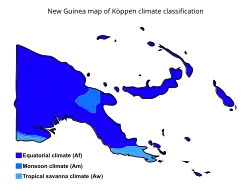 Papua New Guinea map of Köppen climate classification (from New Guinea)
 -
 Jayapura, the most populous and largest city on the island of New Guinea (Papua) (from New Guinea)
 -
 Dutch expeditions in Netherlands New Guinea 1907–1915. (from Western New Guinea)
 -
 Female gable image, Sawos people, Oceanic art in the Bishop Museum (from History of Papua New Guinea)
 -
 New Guinea crocodile (from New Guinea)
 -
 A Japanese military map of New Guinea from 1943 (from New Guinea)
 -
 Hoisting the German flag at Mioko in 1884 (from History of Papua New Guinea)
 -
Dutch expeditions in Netherlands New Guinea 1907–1915. (from Western New Guinea)
-
 A section of Trans-Papua Highway connecting Deiyai and Mimika in Central Papua (from Western New Guinea)
 -
 The lowland rainforest of the Western New Guinea (from Western New Guinea)
 -
 Trans-New Guinea languages (multi-coloured), Austronesian languages (gold), and other languages (grey) (from Western New Guinea)
 -
 Flag under German control of New Guinea. (from History of Papua New Guinea)
 -
-
 Papeda, a notable dish originating from Eastern Indonesia (from Western New Guinea)
 -
New Guinea from 1884 to 1919. The Netherlands controlled the western half of New Guinea, Germany the north-eastern part, and Britain the south-eastern part. (from New Guinea)
-
 Australian patrol officer in 1964 (from History of Papua New Guinea)
 -

-
 New Guinea located in relation to Melanesia (from New Guinea)
 -

-
Regions of Oceania: Australasia, Polynesia, Micronesia, and Melanesia. Physiographically, Australasia includes the Australian landmass (including Tasmania), New Zealand, and New Guinea (from New Guinea)
-
 Fort Du Bus in 1828 (from Western New Guinea)
 -
 Sentani International Airport in Jayapura is the principal point of entry to Papua (from Western New Guinea)
 -
 The Sukarno-era West Irian Liberation Monument in Lapangan Banteng, Jakarta. (from Western New Guinea)
Related portals
WikiProjects

- WikiProject Papua New Guinea
- WikiProject Indonesia
- WikiProject Melanesia
General topics
Categories

Associated Wikimedia
The following Wikimedia Foundation sister projects provide more on this subject:
-
 Commons
Free media repository -
 Wikibooks
Free textbooks and manuals -
 Wikidata
Free knowledge base -
 Wikinews
Free-content news -
 Wikiquote
Collection of quotations -
 Wikisource
Free-content library -
 Wikiversity
Free learning tools -
 Wiktionary
Dictionary and thesaurus
External media

More portals
-
 List of all portals
 -

-

-

-

-

-

-

-

-

-
 Random portal
 -
 WikiProject Portals