Portal:Internet

The Internet Portal  The Internet (or internet) is the global system of interconnected computer networks that uses the Internet protocol suite (TCP/IP) to communicate between networks and devices. It is a network of networks that comprises private, public, academic, business, and government networks of local to global scope, linked by electronic, wireless, and optical networking technologies. The Internet carries a vast range of information services and resources, such as the interlinked hypertext documents and applications of the World Wide Web (WWW), electronic mail, discussion groups, internet telephony, streaming media and file sharing. Most traditional communication media, including telephone, radio, television, paper mail, newspapers, and print publishing, have been transformed by the Internet, giving rise to new media such as email, online music, digital newspapers, news aggregators, and audio and video streaming websites. The Internet has enabled and accelerated new forms of personal interaction through instant messaging, Internet forums, and social networking services. Online shopping has also grown to occupy a significant market across industries, enabling firms to extend brick and mortar presences to serve larger markets. Business-to-business and financial services on the Internet affect supply chains across entire industries. (Full article...) Selected article
Selected picture Webcams are small cameras, (usually, though not always, video cameras) whose images can be accessed using the World Wide Web, instant messaging, or a PC video conferencing application. The term webcam is also used to describe the low-resolution digital video cameras designed for such purposes, but which can also be used to record in a non-real-time fashion. Good Articles -Fucking Machines (also known as fuckingmachines.com and fuckingmachines) is a pornographic website founded in 2000 that features video and photographs of women engaged in autoerotic sexual stimulation with penetrative sex-machines and sex toys. Based in San Francisco, California, the site is operated by Kink.com. Web entrepreneur Peter Acworth launched Fucking Machines on September 25, 2000, as his company's second website after Kink.com. Devices shown on the site were created with the intent to bring women authentic orgasms. Performers were instructed to allow themselves to be recorded experiencing pleasure. After the site applied in 2005 to trademark the phrase "fuckingmachines", the United States Patent and Trademark Office (USPTO) denied the application and ruled that the mark was obscene. Free speech lawyer Marc Randazza represented the site and appealed the decision. Orlando Weekly called his legal brief "one of the most entertaining legal documents you're likely to come across." The appeal was denied in April 2008 and the case was terminated. Randazza's argument in the case became known as The Fuck Brief. The website has been the subject of attention from journalists and academics studying sexuality. Writer Regina Lynn highlighted the site's emphasis on communication, and Annalee Newitz of AlterNet classed it as part of Porn 2.0. Violet Blue wrote in The Adventurous Couple's Guide to Sex Toys that it helped popularize the idea of machines aiding in sex acts. The 2008 edition of The Oxford Encyclopedia of Women in World History described the aesthetic of the devices as disturbing. Jessica Roy wrote for The New York Observer that Fucking Machines' examples of orgasms were a form of transhumanism. Sarah Schaschek devoted a chapter to the phenomenon in Screening the Dark Side of Love: From Euro-Horror to American Cinema, titled "Fucking Machines: High-Tech Bodies in Pornography". She observed, "Strictly speaking, the women in these videos are both the controllers and the controlled." (Full article...) WikiProjects
Did you know (auto-generated) -
Selected biography
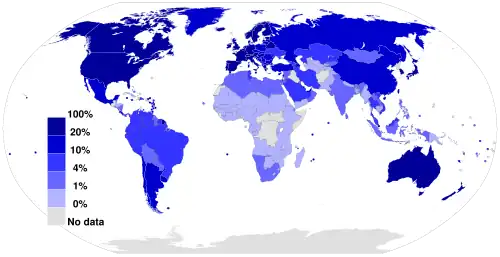
General images -The following are images from various internet-related articles on Wikipedia.
Selected quoteMain topics
Featured contentCategories Select [►] to view subcategories
Internet Internet by continent Internet by country Internet-related lists Internet access Internet architecture Internet broadcasting Internet culture Internet databases Email Internet events Internet governance History of the Internet Internet hosting Hypermedia Internet Geographic information systems Internet law Online algorithms Internet-related organizations People associated with the Internet Politics and the Internet Internet security Internet Standards Internet terminology Videotelephony Works about the Internet World Wide Web Internet stubs Related portalsThings you can do
Associated WikimediaThe following Wikimedia Foundation sister projects provide more on this subject:
Wikipedia's portalsDiscover Wikipedia using portals
|




_(page_62_crop).jpg)


-en.svg.png)