Ancient Rome began as an Italic settlement, traditionally dated to 753 BC, beside the River Tiber in the Italian Peninsula. The settlement grew into the city and polity of Rome, and came to control its neighbours through a combination of treaties and military strength. It eventually controlled the Italian Peninsula, assimilating the Greek culture of southern Italy (Magna Graecia) and the Etruscan culture, and then became the dominant power in the Mediterranean region and parts of Europe. At its height it controlled the North African coast, Egypt, Southern Europe, and most of Western Europe, the Balkans, Crimea, and much of the Middle East, including Anatolia, the Levant, and parts of Mesopotamia and Arabia. That empire was among the largest empires in the ancient world, covering around 5 million square kilometres (1.9 million square miles) in AD 117, with an estimated 50 to 90 million inhabitants, roughly 20% of the world's population at the time. The Roman state evolved from an elective monarchy to a classical republic and then to an increasingly autocratic military dictatorship during the Empire.
Ancient Rome is often grouped into classical antiquity together with ancient Greece, and their similar cultures and societies are known as the Greco-Roman world. Ancient Roman civilisation has contributed to modern language, religion, society, technology, law, politics, government, warfare, art, literature, architecture, and engineering. Rome professionalised and expanded its military and created a system of government called res publica, the inspiration for modern republics such as the United States and France. It achieved impressive technological and architectural feats, such as the empire-wide construction of aqueducts and roads, as well as more grandiose monuments and facilities. (Full article...)
Selected article -
Solidus depicting Constantine II, and on the reverse Victoria, one of the last deities to appear on Roman coins, gradually transforming into an angel under Christian rule
The study of the economies of the ancient city-state of Rome and its empire during the Republican and Imperial periods remains highly speculative. There are no surviving records of business and government accounts, such as detailed reports of tax revenues, and few literary sources regarding economic activity. Instead, the study of this ancient economy is today mainly based on the surviving archeological and literary evidence that allow researchers to form conjectures based on comparisons with other more recent pre-industrial economies.
During the early centuries of the Roman Republic, it is conjectured that the economy was largely agrarian and centered on the trading of commodities such as grain and wine. Financial markets were established through such trade, and financial institutions, which extended credit for personal use and public infrastructure, were established primarily by interfamily wealth. In times of agricultural and cash shortfall, Roman officials and moneyers tended to respond by coining money, which happened during the prolonged crisis of the First Punic War and created economic distortion and difficulties. (Full article...)
Image 21Cinerary urn for the freedman Tiberius Claudius Chryseros and two women, probably his wife and daughter (from Roman Empire)
Image 22Landscape resulting from the ruina montium mining technique at Las Médulas, Spain, one of the most important gold mines in the Roman Empire (from Roman Empire)
Image 23Roman cities in the Imperial period (from Roman Empire)
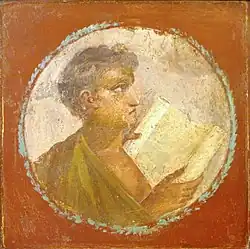
Image 28Pride in literacy was displayed through emblems of reading and writing, as in this portrait of Terentius Neo and his wife (c. 20 AD). (from Roman Empire)
Image 37Forum of Gerasa (Jerash in present-day Jordan), with columns marking a covered walkway (stoa) for vendor stalls, and a semicircular space for public speaking (from Roman Empire)
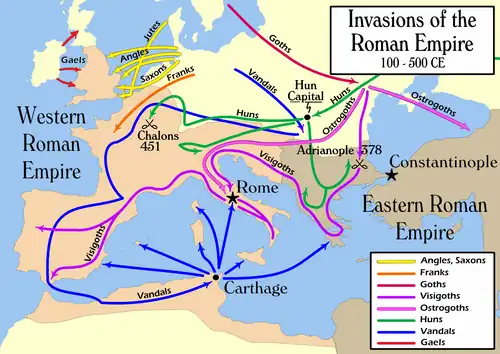
Image 42The Roman Empire by 476, noting western and eastern divisions (from Roman Empire)
Image 43Excavation on the Palatine Hill has found the foundations of a hut believed to correspond to the Hut of Romulus, which the Romans themselves preserved into late antiquity. (from Founding of Rome)
Image 50Mosaic depicting a theatrical troupe preparing for a performance (from Culture of ancient Rome)
Image 51A fresco from Pompeii depicting the foundation of Rome. Sol riding in his chariot; Mars descending from the sky to Rhea Silvia lying in the grass; Mercury shows to Venus the she-wolf suckling the twins; in the lower corners of the picture: river-god Tiberinus and water-goddess Juturna. 35–45 AD. (from Founding of Rome)
Image 52Dressing of a priestess or bride, Roman fresco from Herculaneum, Italy (30–40 AD) (from Roman Empire)
Image 63Solidus issued under Constantine II, and on the reverse Victoria, one of the last deities to appear on Roman coins, gradually transforming into an angel under Christian rule (from Roman Empire)
Trajan (/ˈtreɪ.dʒən/TRAY-jən; born Marcus Ulpius Traianus, 18 September 53 – c. 9 August 117) was a Roman emperor from AD 98 to 117, remembered as the second of the Five Good Emperors of the Nerva–Antonine dynasty. He was a philanthropic ruler and a successful soldier-emperor who presided over one of the greatest military expansions in Roman history, during which, by the time of his death, the Roman Empire reached its maximum territorial extent. He was given the title of optimus princeps ('the best ruler') by the Roman Senate.
...That according to Suetonius, Caligula "often sent for men whom he had secretly killed, as though they were still alive, and remarked offhandedly a few days later that they must have committed suicide"?
...That Mark Antony, who avenged Julius Caesar, was killed by Julius Caesar's grand nephew (Octavian) Augustus Caesar?
...That Sulla's grave read No friend ever surpassed him in kindness, and no enemy in ill-doing?
Marcus Aurelius (April 26, 121 CE. – March 17, 180 CE.), was Roman Emperor from CE 161 to 180 who defeated several significant invasions and put down a revitalisation of the Parthian Empire. His Stoic tome Meditations, which he wrote while on campaign, is still revered as a literary monument to a philosophy of service and duty.
The following WikiProjects are related to Ancient Rome:
WikiProject Classical Greece and Rome: The project regularly invites its members to collaborate on article development.
WikiProject Rome: Includes stylistic help and lists of articles requiring attention or expansion.
WikiProject Military history: Highly-active WikiProject with regular competitions to improve military history articles.
Things you can do
Tasks clipboard
Add a fact which our readers would find interesting as a Did you know? entry.
Add relevant quotes about Rome or by a Roman to the Quotes section.
Expand the Ancient Rome article with a referenced fact, or copy-edit the article prose to improve its quality.
Quotes
“
[...] Caesar is a god in his own city. Outstanding in war or peace, it was not so much his wars that ended in great victories, or his actions at home, or his swiftly won fame, that set him among the stars, a fiery comet, as his descendant. There is no greater achievement among Caesar's actions than that he stood father to our emperor. Is it a greater thing to have conquered the sea-going Britons; to have led his victorious ships up the seven-mouthed flood of the papyrus-bearing Nile; to have brought the rebellious Numidians, under Juba of Cinyps, and Pontus, swollen with the name of Mithridates, under the people of Quirinus; to have earned many triumphs and celebrated few; than to have sponsored such a man, with whom, as ruler of all, you gods have richly favoured the human race? Therefore, in order for the emperor not to have been born of mortal seed, Caesar needed to be made a god. [...]
Augustus, his 'son', will ensure that he ascends to heaven as a god, and is worshipped in the temples. Augustus, as heir to his name, will carry the burden placed upon him alone, and will have us with him, in battle, as the most courageous avenger of his father's murder. Under his command, the conquered walls of besieged Mutina will sue for peace; Pharsalia will know him; Macedonian Philippi twice flow with blood; and the one who holds Pompey's great name, will be defeated in Sicilian waters; and a Roman general's Egyptian consort, trusting, to her cost, in their marriage, will fall, her threat that our Capitol would bow to her city of Canopus, proved vain.
Why enumerate foreign countries or the nations living on either ocean shore? Wherever earth contains habitable land, it will be his: and even the sea will serve him!


.png)


.jpg)


_-_Napoli_MAN_8834.jpg)

_01.JPG)


_-_Arte_Romana_-_Photo_Paolo_Villa_FO232047_ombre_gimp_bis.jpg)


_(5917668745).jpg)




.jpg)


.JPG)

%252C_et%C3%A0_claudia.jpg)
.svg.png)



_-_Napoli_MAN_9022.jpg)





.jpg)

.jpg)


.jpg)