Classical Greek culture, especially philosophy, had a powerful influence on ancient Rome, which carried a version of it throughout the Mediterranean and much of Europe. For this reason, Classical Greece is generally considered the cradle of Western civilization, the seminal culture from which the modern West derives many of its founding archetypes and ideas in politics, philosophy, science, and art. (Full article...)
Selected article -
Theatrical scene with two comedic actors on a Sicilian red-figure calyx-krater c. 350–340 BC.
Ancient Greek comedy (Ancient Greek: κωμῳδία, romanized: kōmōidía) was one of the final three principal dramatic forms in the theatre of classical Greece; the others being tragedy and the satyr play. Greek comedy was distinguished from tragedy by its happy endings and use of comically exaggerated character archetypes, the latter feature being the origin of the modern concept of the comedy. Athenian comedy is conventionally divided into three periods; Old Comedy survives today largely in the form of the eleven extant plays of Aristophanes; Middle Comedy is largely lost and preserved only in relatively short fragments by authors such as Athenaeus of Naucratis; New Comedy is known primarily from the substantial papyrus fragments of Menander. A burlesque dramatic form that blended tragic and comic elements, known as phlyax play or hilarotragedy, developed in the Greek colonies of Magna Graecia by the late 4th century BC.
The philosopher Aristotle wrote in his Poetics (c. 335 BC) that comedy is a representation of laughable people and involves some kind of blunder or ugliness which does not cause pain or disaster. C. A. Trypanis wrote that comedy is the last of the great species of poetry Greece gave to the world. (Full article...)
Arcadia (/ɑːrˈkeɪdiə/; Greek: Ἀρκαδία, romanized: Arkadía) is a region in the central Peloponnese, Greece. It takes its name from the mythological character Arcas, and in Greek mythology it was the home of the gods Hermes and Pan. In European Renaissance arts, Arcadia was celebrated as an unspoiled, harmonious wilderness; as such, it was referenced in popular culture.
Pericles (/ˈpɛrɪkliːz/ⓘ; Ancient Greek: Περικλῆς; c. 495–429 BC) was a Greek statesman
and general during the Golden Age of Athens. He was prominent and influential in Ancient Athenian politics, particularly between the Greco-Persian Wars and the Peloponnesian War, and was acclaimed by Thucydides, a contemporary historian, as "the first citizen of Athens". Pericles turned the Delian League into an Athenian empire and led his countrymen during the first two years of the Peloponnesian War. The period during which he led Athens as its preeminent orator and statesman, roughly from 461 to 429 BC, is sometimes known as the "Age of Pericles", but the period thus denoted can include times as early as the Persian Wars or as late as the following century.
Pericles promoted the arts and literature, and it was principally through his efforts that Athens acquired the reputation of being the educational and cultural centre of the ancient Greek world. He started an ambitious project that generated most of the surviving structures on the Acropolis, including the Parthenon. This project beautified and protected the city, exhibited its glory, and gave work to its people. Pericles also fostered Athenian democracy to such an extent that critics called him a populist. Pericles was descended, through his mother, from the powerful and historically influential Alcmaeonid family. He, along with several members of his family, succumbed to the Plague of Athens in 429 BC, which weakened the city-state during a protracted conflict with Sparta. (Full article...)
Image 8Early Athenian coin, depicting the head of Athena on the obverse and her owl on the reverse – 5th century BC (from Ancient Greece)
Image 9Geometric-style box in the shape of a barn. On display in the Ancient Agora Museum in Athens, housed in the Stoa of Attalus. From early geometric cremation burial of a wealthy pregnant woman, 850 BC. (from Greek Dark Ages)
Image 24The gymnasium and palaestra at Olympia, the site of the ancient Olympic games. The archaic period conventionally dates from the first Olympiad. (from Archaic Greece)
Image 25Dipylon Vase of the late Geometric period, or the beginning of the Archaic period, c. 750 BC. (from Ancient Greece)
Image 26An Ancient Greek pair of terracotta boots. Early geometric period cremation burial of a woman, 900 BC. Ancient Agora Museum in Athens. (from Greek Dark Ages)
Image 27Finds from an early Geometric cremation burial of a pregnant wealthy woman, from the N.W. of the Areopagus, about 850 BC, Ancient Agora Museum (Athens); exhibit 14–16: broad gold finger rings; exhibit 17–19: gold finger rings; 20: pair of gold earrings with trapezoid endings (from Greek Dark Ages)
Image 32Greek hoplite and Persian warrior depicted fighting, on an ancient kylix, 5th century BC (from Ancient Greece)
Image 33Homer, author of the earliest surviving Greek literature (from Archaic Greece)
Image 34The Parthenon, a temple dedicated to Athena, located on the Acropolis in Athens, is one of the most representative symbols of the culture and sophistication of the ancient Greeks. (from Ancient Greece)
A krater (from the Greekverb κεράννυμι, meaning "I mix") was a vase used to mix wine and water. At a Greek symposium, kraters were placed in the center of the room. They were quite large, so they were not easily portable when filled.

.jpg)


 The Victorious Youth (c. 310 BC) is a rare, water-preserved bronze sculpture from ancient Greece. (from Ancient Greece)
 Ancient Greek colonies in the archaic period (from Archaic Greece)
 Events of the first phases of the Greco-Persian Wars (from Ancient Greece)
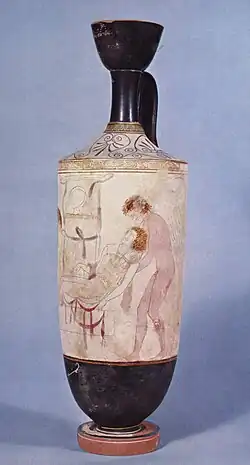 A scene from the Iliad: Hypnos and Thanatos carrying the body of Sarpedon from the battlefield of Troy; detail from an Attic white-ground lekythos, c. 440 BC (from Ancient Greece)
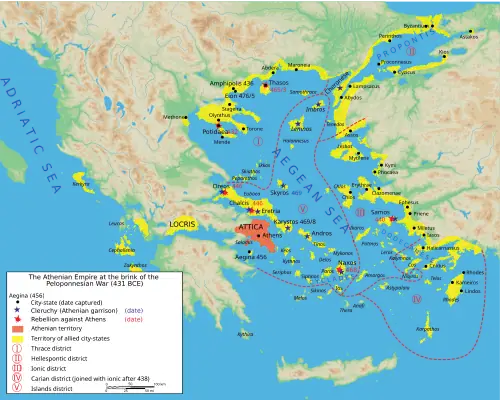 The Delian League immediately before the Peloponnesian War in 431 BC (from Ancient Greece)
.jpg) The ancient Theatre of Epidaurus, 4th century BC (from Ancient Greece)
The ancient Theatre of Epidaurus, 4th century BC (from Ancient Greece)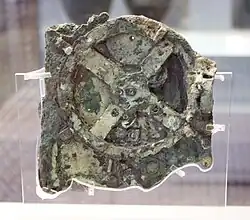 The Antikythera mechanism was an analog computer from 150 to 100 BC designed to calculate the positions of astronomical objects. (from Ancient Greece)
 Early Athenian coin, depicting the head of Athena on the obverse and her owl on the reverse – 5th century BC (from Ancient Greece)
 Geometric-style box in the shape of a barn. On display in the Ancient Agora Museum in Athens, housed in the Stoa of Attalus. From early geometric cremation burial of a wealthy pregnant woman, 850 BC. (from Greek Dark Ages)
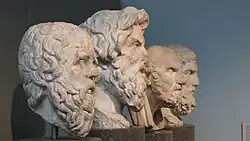 The carved busts of four ancient Greek philosophers, on display in the British Museum. From left to right: Socrates, Antisthenes, Chrysippus, and Epicurus. (from Ancient Greece)
.JPG)
 The lawgiver Solon reformed the Athenian constitution, which led to significant developments in Greece (from Archaic Greece)
 Major regions of mainland ancient Greece and adjacent "barbarian" lands (from Ancient Greece)
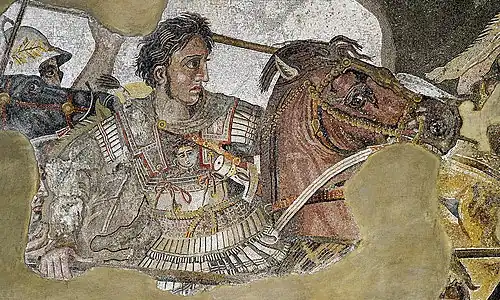 Alexander Mosaic, National Archaeological Museum, Naples (from Ancient Greece)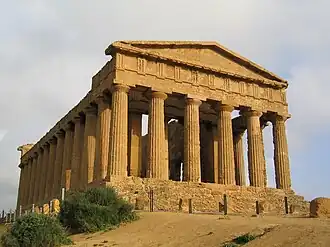
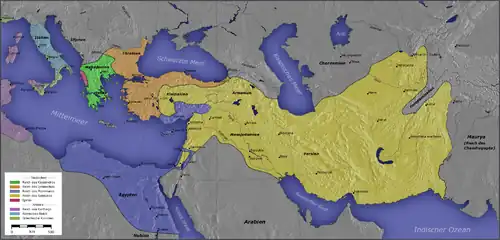 The major Hellenistic realms included the Diadochi kingdoms:Kingdom of Ptolemy I SoterKingdom of CassanderKingdom of LysimachusKingdom of Seleucus I NicatorAlso shown on the map:Carthage (non-Greek)Rome (non-Greek)
.jpg) The Vix Krater, an imported Greek wine-mixing bronze vessel found in the Hallstatt/La Tène grave of the "Lady of Vix", Burgundy, France, c. 500 BC (from Archaic Greece)
The Vix Krater, an imported Greek wine-mixing bronze vessel found in the Hallstatt/La Tène grave of the "Lady of Vix", Burgundy, France, c. 500 BC (from Archaic Greece) Marble bust of Pericles with a Corinthian helmet, Roman copy of a Greek original, Museo Chiaramonti, Vatican Museums; Pericles was a key populist political figure in the development of the radical Athenian democracy. (from Ancient Greece)
 Ruins of the Temple of Apollo within the polis of Ancient Corinth, built c. 540 BC, with the Acrocorinth (the city's acropolis) seen in the background (from Archaic Greece)
 Inheritance law, part of the Gortyn code, Crete, fragment of the 11th column. Limestone, 5th century BC (from Ancient Greece)
 The gymnasium and palaestra at Olympia, the site of the ancient Olympic games. The archaic period conventionally dates from the first Olympiad. (from Archaic Greece)
 Dipylon Vase of the late Geometric period, or the beginning of the Archaic period, c. 750 BC. (from Ancient Greece)
 An Ancient Greek pair of terracotta boots. Early geometric period cremation burial of a woman, 900 BC. Ancient Agora Museum in Athens. (from Greek Dark Ages)
 Finds from an early Geometric cremation burial of a pregnant wealthy woman, from the N.W. of the Areopagus, about 850 BC, Ancient Agora Museum (Athens); exhibit 14–16: broad gold finger rings; exhibit 17–19: gold finger rings; 20: pair of gold earrings with trapezoid endings (from Greek Dark Ages)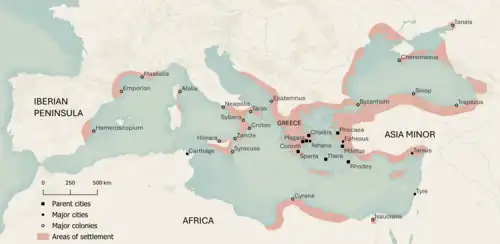

 The remains of the Temple of Apollo in Corinth, the first Greek temple to be built in stone. (from Archaic Greece)
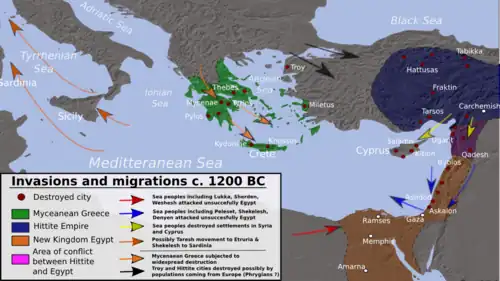 Map of the Late Bronze Age collapse (c. 1200 BC) in the Eastern Mediterranean (from Greek Dark Ages)
 Greek hoplite and Persian warrior depicted fighting, on an ancient kylix, 5th century BC (from Ancient Greece)
 Homer, author of the earliest surviving Greek literature (from Archaic Greece)


 Commons
 Wikibooks
 Wikidata
 Wikinews
 Wikiquote
 Wikisource
 Wikiversity
 Wiktionary
 List of all portals





 Random portal
 WikiProject Portals