Cyperus diandrus
| Cyperus diandrus | |
|---|---|

| |
| North shore of Lake Ontario, Canada in August | |
Scientific classification 
| |
| Kingdom: | Plantae |
| Clade: | Tracheophytes |
| Clade: | Angiosperms |
| Clade: | Monocots |
| Clade: | Commelinids |
| Order: | Poales |
| Family: | Cyperaceae |
| Genus: | Cyperus |
| Species: | C. diandrus
|
| Binomial name | |
| Cyperus diandrus | |
| Synonyms[3] | |
|
Homotypic synonyms
Heterotypic synonyms
| |

Cyperus diandrus, also known as umbrella flatsedge, is a species of flowering plant in the sedge family Cyperaceae. It is native to northeastern North America. It is sometimes confused with Cyperus bipartitus, both of which have chestnut-brown scales protecting the flowers. At one time, botanists considered the latter to be a variety of Cyperus diandrus.
Description
Cyperus diandrus is an annual sedge with fibrous roots. There are multiple stems at the base of the plant. A stem rarely exceeds 25 cm (9.8 in) in height. Above the stem, the inflorescence bears clusters of spikelets, each with numerous florets. There are 2–3 leaf-like bracts at the base of the inflorescence. The main cluster of spikelets at the top of the stem is stalkless, accompanied by 0–4 additional clusters on stalks up to 6 cm long. Each cluster supports 6–12 flattened spikelets. The terminal spikelet is usually erect. A spikelet consists of 8–28 florets, each covered by a scale (a type of bract in sedges and grasses). Each floret is bisexual with 2 (occasionally 3) anthers and a single style with two branched stigmas. The anthers and stigmas emerge from the axil of the floral scale but a perianth is absent. The fruit is an achene.[4][5]

Cyperus diandrus is sometimes confused with Cyperus bipartitus, both of which have pigmented floral scales ranging in color from reddish-brown to purplish-brown. The two species may be distinguished by the pigmented pattern on the surface of the scales.[5][6][7] Occasionally the scales will be entirely pale greenish-white.[8] Cyperus diandrus has conspicuous, persistent styles while those of Cyperus bipartitus are shorter and less conspicuous. The long styles of Cyperus diandrus give its spikelets a woolly appearance.


Taxonomy
Cyperus diandrus was named and described by the American botanist John Torrey in 1819.[2] Its type specimen was collected in salt marshes near New York City.[9] Torrey referred to the species as the "diandrous galingale".[10] As of February 2026, the botanical name Cyperus diandrus Torr. is widely accepted.[3][11][12][13]
In 1813, the German-American botanist Frederick Traugott Pursh described a variety of Cyperus flavescens with chestnut-brown spikelets.[14] Pursh's description was based on specimens from New York, Vermont, and Massachusetts.[15] In 1836, Torrey published the name Cyperus diandrus var. castaneus based on Pursh's variety.[16] Torrey described a taxon with cespitose habit, shining dark-chestnut scales, and relatively short styles.[17][18] As of February 2026, the name Cyperus diandrus var. castaneus (Pursh) Torr. is considered to be a synonym of Cyperus bipartitus Torr.[19]
| Cyperus diandrus | Cyperus bipartitus (syn. Cyperus diandrus var. castaneus) | |
|---|---|---|
| Spikelets | Flatly compressed | Less so |
| Scales, shape | Oblong, with obtuse tips | Longer and narrower, very closely imbricated (overlapping) |
| Scales, pigment | Thin band of pigment along the margin, with a conspicuous pale area on the face of the scale | More heavily pigmented such that a pale area is lacking |
| Scales, texture | Membranaceous (thin, pliable) | Coriaceous (leathery), with a firmer texture |
| Styles | Much exserted beyond the scales (2–4 mm); three or four times the length of the achene; 2-cleft nearly to the base; straight | Scarcely exserted beyond the scales(<2 mm); about twice the length of the achene; less deeply cleft; usually making a short double curvature toward the base |
| Achenes | Oblong-obovate, slightly scabrous, dull | Orbicular-obovate, minutely wrinkled transversely |
Distribution and habitat
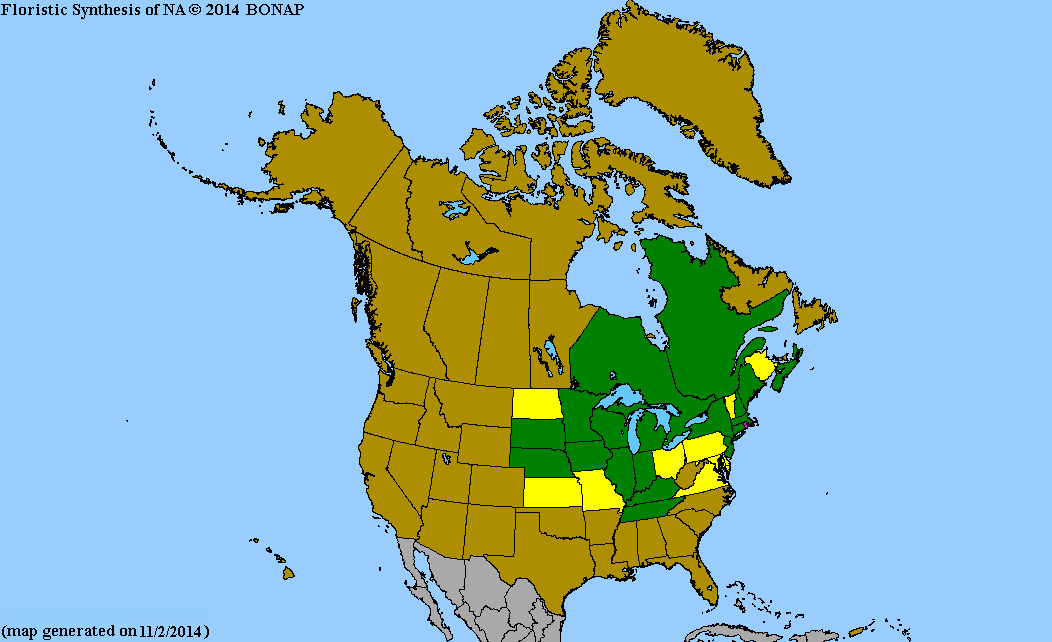
Cyperus diandrus is native to northeastern North America, ranging from Ontario and Nebraska to Nova Scotia and Virginia.[20] It was introduced in the state of Washington.[21] It grows on shorelines in sandy, peaty and slightly brackish habitats, usually not in disturbed areas.[4]
Ecology
Cyperus diandrus is a flowering plant whose season runs from July to October.[22]
Conservation
As of February 2026, the NatureServe global conservation status of Cyperus diandrus is secure (G5).[1] It is imperiled (S2) in Pennsylvania.[23]
See also
References
- ^ a b NatureServe (30 January 2026). "Cyperus diandrus". NatureServe Explorer. Arlington, Virginia. Retrieved 3 February 2026.
- ^ a b "Cyperus diandrus Torr.". International Plant Names Index (IPNI). Royal Botanic Gardens, Kew; Harvard University Herbaria & Libraries; Australian National Botanic Gardens. Retrieved 3 February 2026.
- ^ a b "Cyperus diandrus Torr.". Plants of the World Online. Royal Botanic Gardens, Kew. Retrieved 3 February 2026.
- ^ a b Tucker, Gordon C.; Marcks, Brian G.; Carter, J. Richard (2002). "Cyperus diandrus". In Flora of North America Editorial Committee (ed.). Flora of North America North of Mexico (FNA). Vol. 23. New York and Oxford: Oxford University Press. Retrieved 3 February 2026 – via eFloras.org, Missouri Botanical Garden, St. Louis, MO & Harvard University Herbaria, Cambridge, MA.
- ^ a b "Cyperus diandrus (Umbrella Flatsedge)". Minnesota Wildflowers. Retrieved 4 February 2026.
- ^ "Comparison of Cyperus bipartitus and Cyperus diandrus spikelets". Minnesota Wildflowers. Retrieved 3 February 2026.
- ^ "Cyperus diandrus — umbrella flatsedge". Go Botany. Native Plant Trust. Retrieved 3 February 2026.
- ^ Reznicek, A. A.; Voss, E. G.; Walters, B. S. (February 2011). "Cyperus". Michigan Flora Online. University of Michigan. Retrieved 2 February 2026.
- ^ Torrey (1819), p. 90.
- ^ Torrey (1843), pp. 338.
- ^ "Cyperus diandrus Torr.". WFO Plant List. Retrieved 4 February 2026.
- ^ "Cyperus diandrus Torrey". Database of Vascular Plants of Canada. Retrieved 4 February 2026.
- ^ NRCS. "Cyperus diandrus". PLANTS Database. United States Department of Agriculture (USDA). Retrieved 4 February 2026.
- ^ "Cyperus flavescens var. castaneus Pursh". International Plant Names Index (IPNI). Royal Botanic Gardens, Kew; Harvard University Herbaria & Libraries; Australian National Botanic Gardens. Retrieved 14 February 2026.
- ^ "Cyperus flavescens var. castaneus Pursh". Global Biodiversity Information Facility. Retrieved 16 February 2026.
- ^ "Cyperus diandrus var. castaneus (Pursh) Torr.". International Plant Names Index (IPNI). Royal Botanic Gardens, Kew; Harvard University Herbaria & Libraries; Australian National Botanic Gardens. Retrieved 9 February 2026.
- ^ Torrey (1836), pp. 251–2.
- ^ Torrey (1843), pp. 338–339.
- ^ "Cyperus diandrus var. castaneus (Pursh) Torr.". Plants of the World Online. Royal Botanic Gardens, Kew. Retrieved 9 February 2026.
- ^ Kartesz, John T. (2014). "Cyperus diandrus". State-level distribution map from the North American Plant Atlas (NAPA). Biota of North America Program (BONAP). Retrieved 3 February 2026.
- ^ "Cyperus diandrus (umbrella flatsedge)". Burke Herbarium. Retrieved 10 February 2026.
- ^ "Cyperus diandrus Torrey". Flora of the Southeastern United States. Retrieved 3 February 2026.
- ^ "Umbrella Flatsedge Cyperus diandrus" (PDF). Pennsylvania Natural Heritage Program. Retrieved 10 February 2026.

Bibliography
- Torrey, John (1819). A catalogue of plants, growing spontaneously within thirty miles of the City of New-York. Albany: Lyceum of Natural History of New York. Retrieved 3 February 2026.
- Torrey, John (1836). "Monograph of the North American Cyperaceae". Annals of the Lyceum of Natural History of New York. 3: 239–448. Retrieved 12 January 2026.
- Torrey, John (1843). Flora of the State of New York. Vol. 2. Albany: Carroll and Cook. Retrieved 12 February 2026.
External links

- "Cyperus diandrus Torr.". World Flora Online. Retrieved 11 February 2026.
- "Cyperus diandrus". Lady Bird Johnson Wildflower Center. The University of Texas at Austin. Retrieved 3 February 2026.
- "Cyperus diandrus". New York Flora Atlas. Retrieved 10 February 2026.
- "Cyperus diandrus Torrey". Digital Atlas of the Virginia Flora. Retrieved 10 February 2026.
- "Cyperus diandrus". Indiana Plant Atlas. Retrieved 10 February 2026.
- Kartesz, John T. (2014). "Cyperus diandrus". County-level distribution map from the North American Plant Atlas (NAPA). Biota of North America Program (BONAP). Retrieved 3 February 2026.
- "Cyperus niger var. castaneus Kük.". International Plant Names Index (IPNI). Royal Botanic Gardens, Kew; Harvard University Herbaria & Libraries; Australian National Botanic Gardens. Retrieved 15 February 2026.
