C/2025 K1 (ATLAS)
_2025-10-29.jpg) Comet C/2025 K1 (ATLAS) photographed on 29 October 2025 | |
| Discovery[1] | |
|---|---|
| Discovery site | ATLAS–CHL (W68) |
| Discovery date | 24 May 2025 |
| Designations | |
| CK25K010,[2] A11nyuL | |
| Orbital characteristics[7] | |
| Epoch | 27 August 2025 (JD 2460914.5) |
| Observation arc |
|
| Earliest precovery date | 8 April 2025 |
| Number of observations | 2,372 |
| Perihelion | 0.334 AU |
| Eccentricity | |
| Inclination |
|
| 97.557° | |
| Argument of periapsis | 271.02° |
| Mean anomaly | –0.001° |
| Last perihelion | 8 October 2025 |
| Earth MOID | 0.161 AU |
| Jupiter MOID | 2.31 AU |
| Physical characteristics[8] | |
Mean radius | 1–2 km (0.62–1.24 mi)[b] |
| Comet total magnitude (M1) | 14.1 |
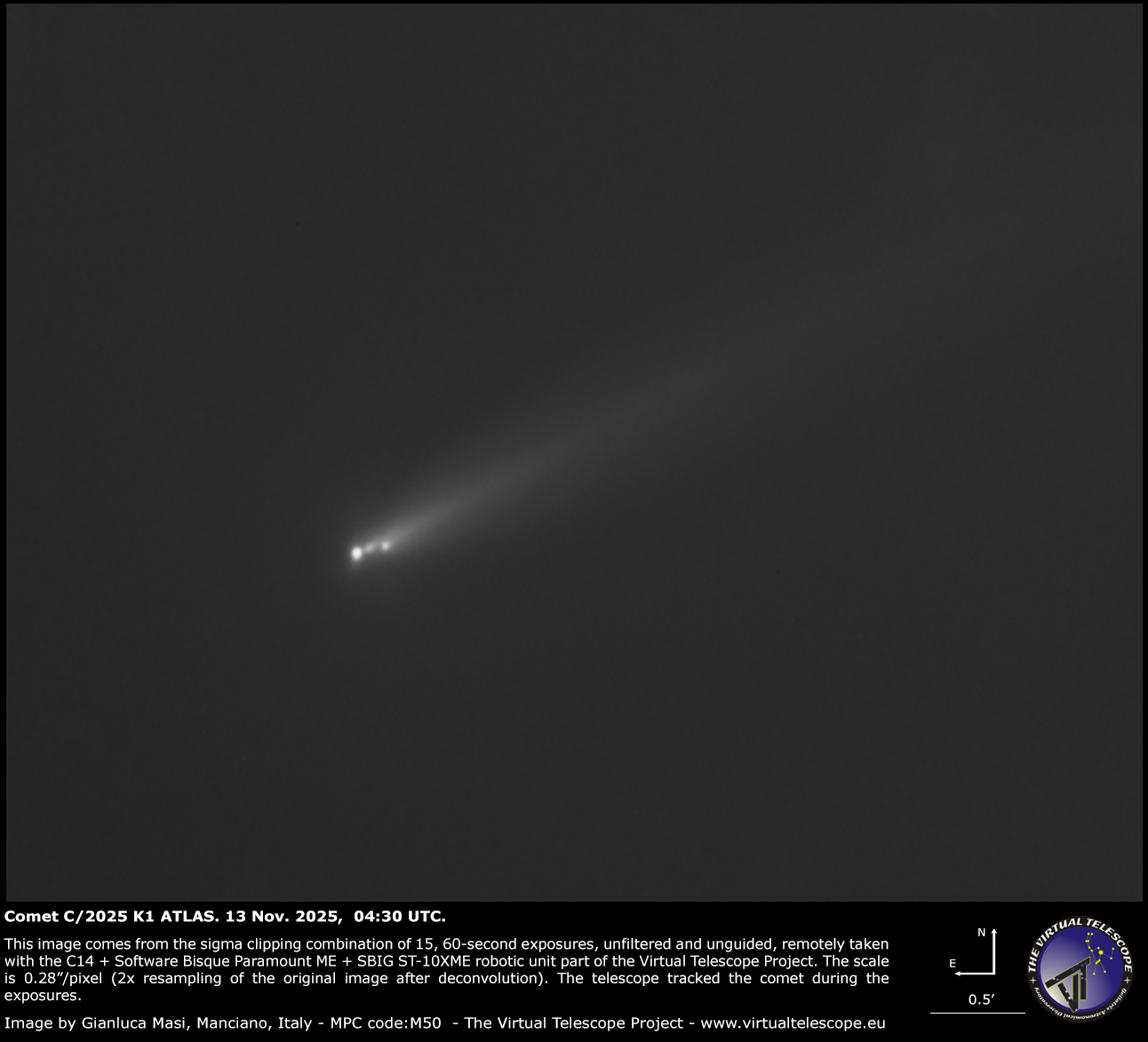
C/2025 K1 (ATLAS) is a non-periodic comet first seen in May 2025. It is one of many comets discovered by the Asteroid Terrestrial-impact Last Alert System (ATLAS). The comet is dynamically new, having come directly from the Oort cloud.[3] With perihelion only 0.33 AU (49 million km; 31 million mi) from the Sun, the comet was not expected to survive perihelion passage,[9] but it did and was recovered on 18 October 2025. The comet has broken into multiple fragments and fragments A+B+C+D may be ejected from the Solar System.[10][a]
Observational history
The comet was first discovered on 24 May 2025 as an apparently asteroid-like object (temporarily designated as A11nyuL) from the ATLAS facility at Rio Hurtado, Chile.[1] At the time, it was a 19th-magnitude object with a slightly diffuse coma within the constellation Pegasus.[c] Observations from the Siding Spring Observatory noted a tail about 7.5 arcseconds long and a coma about 1.5 arcseconds across, brightening up to apparent magnitude 12.1 by 13 August 2025.[11]
_(iotw2604a).jpg)

Between 24 and 29 September, the comet was spotted in the same area of the sky from the Earth's perspective alongside C/2025 R2 (SWAN) as it gradually moved within the constellation Virgo.[13][14] In early November 2025 the comet experienced two apparent outbursts, with the comet brightening by 0.9 magnitude during the largest of which, on 4 November. On the same date, images by ZTF revealed a parabola of a material up to 10 arcseconds from the nucleus that the next day was not present while the tail had become brighter, which is consistent with the material moving tailwards.[15] This outburst later resulted with the comet experiencing a fragmentation event with two visible components. The fragmentation was first reported on the social media groups comets-ml.groups.io and Facebook by F. Kugel, Dauban Observatory MPC station A77 on October 10, 2025. (Image linked externally) and reported by ATel from the Teide Observatory on 10 November 2025.[16] By 13 November 2025, three fragments were visible.[17][18] By 25 November 2025 a fourth fragment had appeared and fragment-A had brightened significantly, which indicated other fragment(s) could become visible.[19]
On 24 November 2025 the comet passed 0.401 AU (60.0 million km; 37.3 million mi) from Earth,[20] and about 12 degrees from Dubhe in the Big Dipper. Additional observations from the Gemini North telescope in December 2025,[21] and the James Webb Space Telescope (JWST) in January 2026,[22] had detected the second fragmentation event that occurred on the comet's Fragment C.[21][22]
Images captured by Gemini North on 11 November and 6 December 2025 showed three suspected fragments of the comet's nucleus, each fluctuating in brightness, density, and position from night to night.[12]
| Fragment | Time | Earth distance |
|---|---|---|
| C/2025 K1-B[23] | 2025-Nov-24 17:05:03 | 0.40175 AU (60,101,000 km; 37,345,000 mi) |
| C/2025 K1-C[24] | 2025-Nov-24 17:05:34 | 0.40121 AU (60,020,000 km; 37,295,000 mi) |
| C/2025 K1-A[20] | 2025-Nov-24 17:06:31 | 0.40129 AU (60,032,000 km; 37,302,000 mi) |
Physical characteristics
Spectroscopic observations of the comet conducted from the Asiago Astrophysical Observatory between 3 and 15 August 2025 had revealed that its coma is significantly depleted in carbon-chain molecules, especially diatomic carbon (C2).[25] Additional data obtained from the Lowell Observatory on 19 August 2025 indicated it also has very low CN-to-OH and dust-to-gas ratios compared to other comets.[26] So far, only two other comets were known to have such carbon-poor composition, these were C/1988 Y1 (Yanaka) and 96P/Machholz.[26] On 13 November 2025, as the comet was fragmenting, the optical spectrum was dominated by NH2 while it was depleted in carbon species.[27]
See also
Notes
- ^ a b At a future epoch of 2200, when fragments A+B+D are outside the planetary region of the Solar System, they will retain a weakly hyperbolic trajectory.[3][4][6] Fragment-C will be near parabolic.[5]
- ^ Upper limit of the radii of each fragment due to coma contamination[8]
- ^ Reported initial position upon discovery was: α = 22h 25m 46.46s, δ = 15° 07′ 01.6″[1]
References
- ^ a b c A. Hale; M. Mattiazzo; H. Sato; R. Weryk; et al. (27 May 2025). D. W. Green (ed.). "Comet C/2025 K1 (ATLAS)". Central Bureau for Astronomical Telegrams. 5557: 1. Bibcode:2025CBET.5557....1H.
- ^ Q. Z. Ye; J. Tonry; J. Robinson; R. Siverd; et al. (27 May 2025). "Comet C/2025 K1 (ATLAS)". Minor Planet Electronic Circulars. 2025-K110. Bibcode:2025MPEC....K..110Y. doi:10.48377/MPEC/2025-K110.
- ^ a b c Horizons output. "Barycentric Osculating Orbital Elements for Comet ATLAS (C/2025 K1)". Retrieved 11 February 2026. (Solution using the Solar System's barycenter (Sun+Jupiter). Select Ephemeris Type:Elements and Center:@0)
- ^ a b Horizons output. "Barycentric Osculating Orbital Elements for C/2025 K1-B". Retrieved 8 January 2025. (Solution using the Solar System's barycenter (Sun+Jupiter). Select Ephemeris Type:Elements and Center:@0)
- ^ a b Horizons output. "Barycentric Osculating Orbital Elements for C/2025 K1-C". Retrieved 11 February 2025. (Solution using the Solar System's barycenter (Sun+Jupiter). Select Ephemeris Type:Elements and Center:@0)
- ^ a b Horizons output. "Barycentric Osculating Orbital Elements for C/2025 K1-D". Retrieved 11 February 2025. (Solution using the Solar System's barycenter (Sun+Jupiter). Select Ephemeris Type:Elements and Center:@0)
- ^ "C/2025 K1 (ATLAS) – JPL Small-Body Database Lookup". ssd.jpl.nasa.gov. Jet Propulsion Laboratory. Retrieved 30 October 2025.
- ^ a b D. Bodewits; J. W. Noonan; M. S. P. Kelley; et al. (2025). "Sequential Fragmentation of C/2025 K1 (ATLAS) After Its Near-Sun Passage". arXiv:2511.19707 [astro-ph].
- ^ H. Baker (5 November 2025). "There's another comet ATLAS in our solar system – and it just turned gold after a perilous dance with the Sun". Live Science. Retrieved 6 November 2025.
- ^ B. Turner (14 November 2025). "New image of 'other comet ATLAS' reveals it's breaking apart ahead of close approach to Earth". Live Science. Retrieved 14 November 2025.
- ^ T. Prystavski; E. Bryssinck; J. J. Gonzalez; et al. (21 August 2025). D. W. Green (ed.). "Comet C/2025 K1 (ATLAS)". Central Bureau for Astronomical Telegrams. 5597: 1. Bibcode:2025CBET.5597....1P.
- ^ a b "Comet C/2025 K1 (ATLAS)". NOIRLab. January 2026. Retrieved 29 January 2026.
- ^ Nemiroff, R.; Bonnell, J., eds. (26 September 2025). "A SWAN, an ATLAS, and Mars". Astronomy Picture of the Day. NASA. Retrieved 6 November 2025.
- ^ Nemiroff, R.; Bonnell, J., eds. (29 September 2025). "Two Camera Comets in One Sky". Astronomy Picture of the Day. NASA. Retrieved 6 November 2025.
- ^ M. S. P. Kelley; C. E. Holt; Q. Z. Ye; D. Bodewits (6 November 2025). "Apparent Outbursts of Comet C/2025 K1 (ATLAS)". The Astronomer's Telegram. 17482: 1. Bibcode:2025ATel17482....1K.
- ^ M. Serra-Ricart; J. Licandro; M. R. Alarcon (10 November 2025). "C/2025 K1 (ATLAS): Multiple Fragmentation Observed". The Astronomer's Telegram. 17487: 1. Bibcode:2025ATel17487....1S.
- ^ J. W. Noonan; D. Bodewits; C. Snodgrass; K. W. Wierzchoś; M. Combi (10 November 2025). "Fragmentation of C/2025 K1 (ATLAS)". The Astronomer's Telegram. 17488: 1. Bibcode:2025ATel17488....1N.
- ^ A. Kostov; M. Minev; G. Borisov; T. Bonev (16 November 2025). "Follow up monitoring of the fragmentation of comet C/2025 K1 (ATLAS)". The Astronomer's Telegram. 17495: 1. Bibcode:2025ATel17495....1K.
- ^ "News and information about meteor showers, solar flares, auroras, and near-Earth asteroids". SpaceWeather.com. Retrieved 25 November 2025.
- ^ a b "Earth approach on 24 November 2025". JPL Horizons. Retrieved 11 February 2026.
- ^ a b B. T. Bolin; M. Micheli; D. Farnocchia; et al. (1 January 2026). "Gemini multi-band follow-up of fragmenting Oort cloud comet C/2025 K1 (ATLAS)". The Astronomer's Telegram. 17570: 1. Bibcode:2026ATel17570....1B.
- ^ a b B. T. Bolin; M. Micheli; D. Farnocchia; et al. (15 January 2026). "JWST NIRCam detection of secondary fragmentation in C/2025 K1-C (ATLAS)". The Astronomer's Telegram. 17598: 1. Bibcode:2026ATel17598....1B.
- ^ "Fragment-B Earth approach on 24 November 2025". JPL Horizons. Retrieved 8 January 2025.
- ^ "Fragment-C Earth approach on 24 November 2025". JPL Horizons. Retrieved 11 February 2026.
- ^ F. Manzini; A. Mura; A. Reguitti; P. Ochner; et al. (22 August 2025). "Comet C/2025 K1 (ATLAS) is deeply depleted of C
2". The Astronomer's Telegram. 17351: 1. Bibcode:2025ATel17351....1M. - ^ a b D. G. Schleicher (27 August 2025). "The Depletion of Carbon-Bearing Species in Comet ATLAS (2025 K1)". The Astronomer's Telegram. 17362: 1. Bibcode:2025ATel17362....1S.
- ^ P. Guzik; M. Drahus; M. Sabat (18 November 2025). "Detailed view of the fragmenting comet C/2025 K1 (ATLAS)". The Astronomer's Telegram. 17501: 1. Bibcode:2025ATel17501....1G.
External links

- C/2025 K1-A at the JPL Small-Body Database
- C/2025 K1-B at the JPL Small-Body Database
- C/2025 K1-C at the JPL Small-Body Database
- C/2025 K1-D at the JPL Small-Body Database
- C/2025 K1 at COBS (Comet Observation database)
- C/2025 K1 at Gideon van Buitenen's website
- C/2025 K1 at Seiichi Yoshida's website
Fragmentation images
- Comet C/2025 K1 (ATLAS) fragmentation at Groups.io (10 Nov 2025)
- Comet C/2025 K1 (ATLAS) fragmentation at the Virtual Telescope Project (13 Nov 2025)
Astronomy Pictures of the Day
- NASA Astronomy Picture of the Day: A SWAN, an ATLAS, and Mars (26 September 2025)
- NASA Astronomy Picture of the Day: Two Camera Comets in One Sky (29 September 2025)

.png)
2025 in space | |||
|---|---|---|---|
| |||
Space probe launches  |
|    | |
| Selected NEOs | |||
| Discoveries |
| ||
| Comets | |||
| Novae | |||
| Space exploration | Lucy flyby of 52246 Donaldjohanson | ||
| Miscellaneous events |
| ||
| |||